

If you’re learning Spanish, one of the first questions you’ll want to ask someone is “where are you from in Spanish.” It’s a simple phrase, but there are multiple ways to say it depending on formality, context, and who you’re talking to. Knowing the right version helps you sound more natural and confident in conversations.
In this guide, you’ll learn how to say where are you from in Spanish, when to use formal or informal versions, and real-world examples you can start using immediately. Let’s dive in!
How to Say “Where Are You From in Spanish”
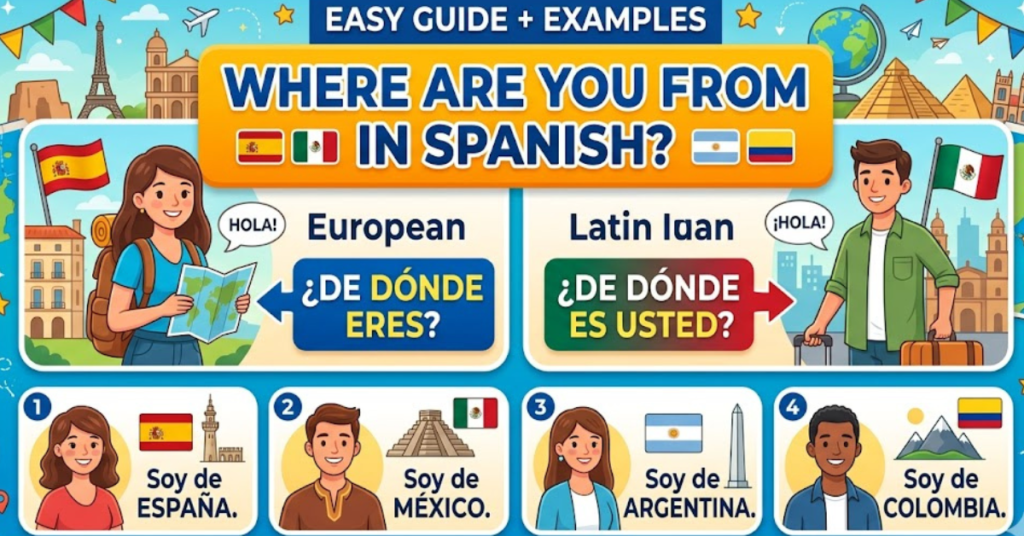
The most common translation of where are you from in Spanish is:
¿De dónde eres? (informal)
¿De dónde es usted? (formal)
Both phrases literally translate to “From where are you?” and are widely used in Spanish-speaking countries.
Quick Breakdown
- ¿De dónde? = From where
- Eres = You are (informal)
- Es usted = You are (formal)
Where Are You From in Spanish Informal
Use this when speaking with:
- Friends
- People your age
- Classmates
- Someone in a casual setting
Example:
- ¿De dónde eres?
- Soy de México. (I am from Mexico.)
This is the most common way how to ask where are you from in Spanish in everyday conversation.
Where Are You From in Spanish Formal
Use the formal version when speaking to:
- Elders
- Teachers
- Professionals
- Someone you just met in a formal environment
Formal version:
¿De dónde es usted?
Example:
- ¿De dónde es usted?
- Soy de España. I am from Spain.
This version is essential if you’re wondering where are you from in Spanish formal.
How Do You Say Where Are You From in Spanish to a Girl
The phrase does not change based on gender. You can still say:
- ¿De dónde eres? (informal)
- ¿De dónde es usted? (formal)
Example conversation:
- Hola, ¿de dónde eres?
- Soy de Colombia.
So if you’re asking where are you from in Spanish to a girl, just use the same structure.
Alternative Ways to Ask Where Are You From in Spanish
Spanish offers a few variations that sound natural:
1. ¿De qué país eres?
(Which country are you from?)
2. ¿Cuál es tu origen?
(What is your origin?)
3. ¿De dónde vienes?
(Where do you come from?)
These variations help if you want to sound more conversational while learning how do i say where are you from in Spanish.
Example Dialogues Real-Life Situations
Casual Conversation
- Marco: Hola, ¿de dónde eres?
- Ana: Soy de Argentina.
This answers searches like marco where are you from in spanish.
Formal Setting
- Buenas tardes, ¿de dónde es usted?
- Soy de Chile.
Pronunciation Tips
To sound natural:
- ¿De dónde eres? → deh DON-deh EH-res
- ¿De dónde es usted? → deh DON-deh es oos-TED
Practice saying it slowly, then speed up as you gain confidence.
Common Mistakes to Avoid
- Saying “Dónde eres” (missing “de”)
- Mixing formal and informal verbs
- Forgetting the opening question mark (¿)
Correct usage:
- ¿De dónde eres?
- ¿De dónde es usted?
When to Use Each Version
| Situation | Phrase |
| Talking to a friend | ¿De dónde eres? |
| Talking to a stranger politely | ¿De dónde es usted? |
| Casual chat | ¿De dónde eres? |
| Professional meeting | ¿De dónde es usted? |
FAQs About “Where Are You From in Spanish”
What is where are you from in Spanish?
The most common translation is ¿De dónde eres?
How do you say where are you from in Spanish formally?
You say ¿De dónde es usted?
How to ask where are you from in Spanish politely?
Use ¿De dónde es usted? for respectful conversations.
How do I say where are you from in Spanish casually?
Use ¿De dónde eres?
Does Spanish change based on gender?
No, the phrase stays the same regardless of whether you’re speaking to a boy or girl.
Conclusion
Learning where are you from in Spanish is one of the easiest and most useful phrases for beginners. Whether you choose ¿De dónde eres? for informal chats or ¿De dónde es usted? for formal conversations, you’ll instantly sound more natural in Spanish.
Practice these variations, try them in real conversations, and you’ll quickly build confidence. Want to keep improving? Explore more basic Spanish questions and start forming full conversations today