

When you look up at the night sky, the Moon feels incredibly close. But just how far away is the moon in reality? The answer isn’t fixed — the Moon’s orbit around Earth is slightly oval-shaped, meaning its distance changes throughout the month. Understanding this distance helps explain supermoons, tides, and even space travel. Let’s break it down in simple terms.
Average Distance Between Earth and the Moon
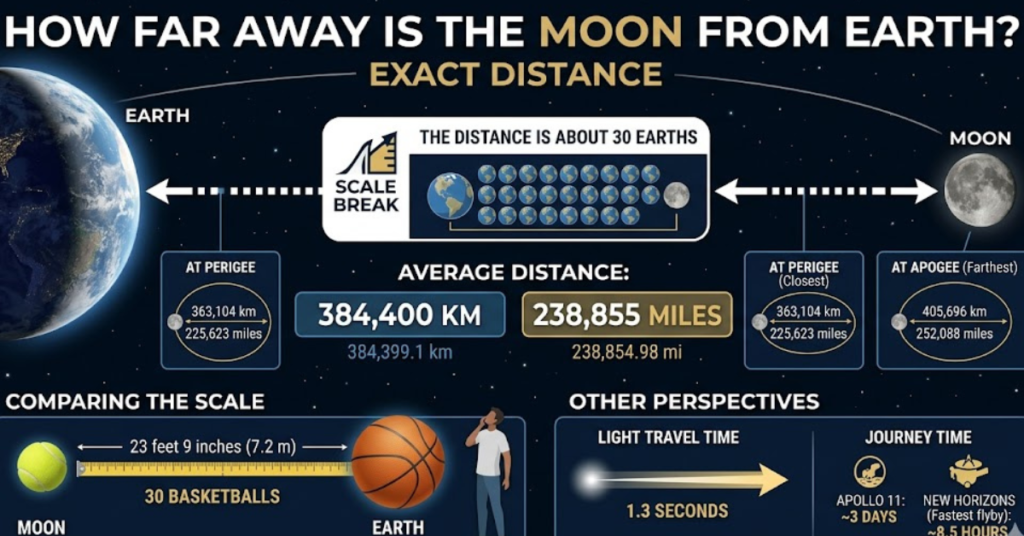
The Moon’s average distance from Earth is:
- 238,855 miles
- 384,400 kilometers
This is called the mean lunar distance. However, because the orbit isn’t perfectly circular, the Moon moves closer and farther during each cycle.
Closest Point — Perigee
- About 225,623 miles (363,104 km)
- Moon appears larger and brighter (Supermoon)
Farthest Point — Apogee
- About 252,088 miles (405,696 km)
- Moon looks slightly smaller
Distance in Miles (Quick Answer)
If you’re searching specifically for how far away is the moon in miles, here’s a quick snapshot:
- Average: 238,855 miles
- Closest: 225,623 miles
- Farthest: 252,088 miles
To visualize this:
- Around 30 Earths could fit between Earth and the Moon
- Light from the Moon reaches us in 1.28 seconds
Travel Time to the Moon
How long would it take to get there? It depends on speed:
- Apollo 11 mission: about 3 days
- Modern spacecraft: 1–3 days
- Commercial airplane speed: about 6 months
This shows how vast space really is, even within our cosmic neighborhood.
Why the Distance Changes
The Moon follows an elliptical orbit, not a perfect circle. Because of this:
- Distance varies every month
- Gravitational forces influence movement
- Earth’s tides play a role
Interestingly, the Moon is slowly drifting away from Earth by:
- 1.5 inches (3.8 cm) per year
How Scientists Measure the Distance
Researchers use precise techniques, including:
Laser Ranging
- Mirrors left by Apollo astronauts reflect lasers
- Distance calculated using light travel time
Radar Signals
- Radio waves bounced off the lunar surface
Spacecraft Tracking
- Satellites provide ultra-accurate measurements
Accuracy today is within a few centimeters.
Fun Facts
- The Moon is Earth’s only natural satellite
- The gap equals roughly 30 Earth diameters
- Billions of years ago, it was much closer
- The Moon stabilizes Earth’s tilt and climate
FAQs
What is the exact distance today?
The distance changes daily but averages 238,855 miles.
Why does the Moon sometimes look bigger?
It’s closer to Earth during perigee, creating a Supermoon.
How long does light take to travel from the Moon?
About 1.28 seconds.
Is the Moon moving away?
Yes, it drifts about 1.5 inches per year.
Could humans drive to the Moon?
Technically yes, but at highway speeds it would take over 160 days without stopping.
Conclusion
The Moon may seem close, but it’s actually nearly 240,000 miles away on average. This distance changes slightly throughout its orbit, influencing everything from tides to eclipses. Understanding these variations gives us a deeper appreciation of Earth’s closest cosmic companion.
Curious about space? Explore more topics like lunar phases, supermoons, or how astronauts travel beyond Earth — there’s always more to discover.