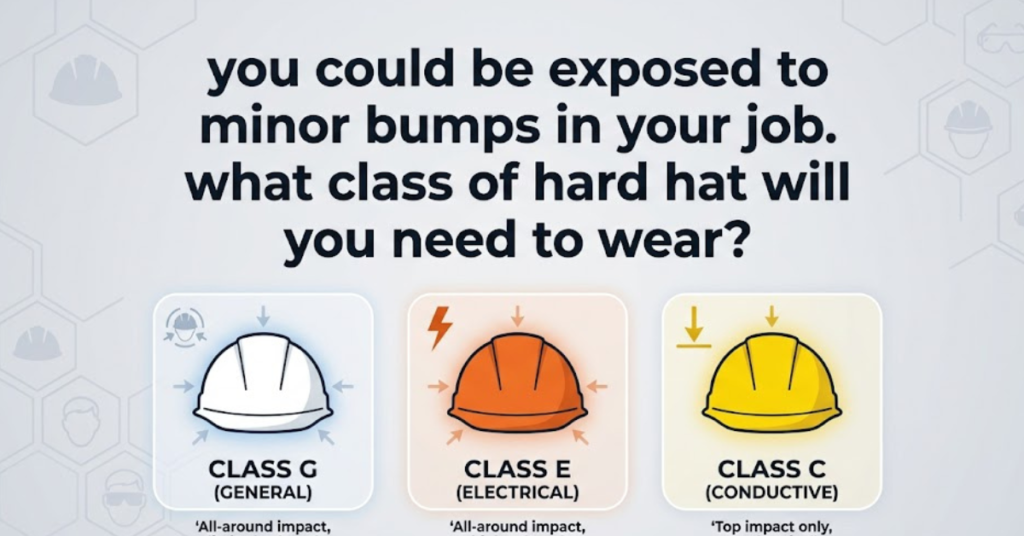

Ever worked in a space where low ceilings, pipes, or beams make you duck constantly? If so, you’ve probably wondered: you could be exposed to minor bumps in your job—what class of hard hat will you need to wear?
It’s a simple question, but the answer is important for your safety. Not every work environment requires heavy-duty head protection, but even minor bumps can lead to injuries if ignored. Let’s break it down in a clear, practical way.
Understanding the Basics of Head Protection
Before choosing the right gear, it helps to know how head protection is categorized.
Hard hats and protective headgear are typically designed to protect against:
- Impact from falling objects
- Contact with fixed objects (like low beams)
- Electrical hazards
However, not all jobs carry the same level of risk. That’s why there are different types and classes of head protection.
The Short Answer: What Should You Wear?
If you could be exposed to minor bumps in your job, the correct choice is usually:
A bump cap (not a full hard hat)
Why?
- Designed specifically for low-risk environments
- Protects against minor impacts and scrapes
- Lightweight and more comfortable for everyday wear
Important: A bump cap is not classified as a hard hat class (like Class G, E, or C) because it’s meant for lighter protection.
What Is a Bump Cap?
A bump cap looks similar to a baseball cap but has a protective plastic insert inside.
Key features:
- Protects against stationary object bumps
- Not suitable for falling objects
- Comfortable for long shifts
- Often used in tight or enclosed spaces
When Do You Need a Real Hard Hat Instead?
If your job involves more than minor bumps, you’ll need a certified hard hat.
Hard hats are categorized by type and class:
Types (Impact Protection):
- Type I: Protection from impacts to the top of the head
- Type II: Protection from top and side impacts
Classes (Electrical Protection):
- Class G (General): Limited electrical protection
- Class E (Electrical): High-voltage protection
- Class C (Conductive): No electrical protection
These are regulated by safety standards like OSHA and ANSI.
Bump Cap vs Hard Hat: Quick Comparison
| Feature | Bump Cap | Hard Hat |
| Protection Level | Minor bumps | Heavy impacts + hazards |
| Falling Objects | No | Yes |
| Electrical Safety | No | (depending on class) |
| Comfort | Lightweight | Heavier |
| Use Case | Low-risk environments | Construction, industrial |
Jobs Where Bump Caps Are Common
You might need a bump cap if you work in:
- Warehouses with low shelving
- Maintenance or repair roles
- Automotive workshops
- Food processing plants
- Confined or low-clearance spaces
In these roles, the main risk is hitting your head on fixed objects—not falling debris.
Safety Tips for Choosing the Right Headgear
Even if the risk seems small, the right protection matters.
Follow these guidelines:
- Assess the hazard level
- Choose a bump cap only for minor impact risks
- Upgrade to a hard hat if there’s falling object danger
- Ensure proper fit and comfort
- Follow workplace safety regulations
When in doubt, always check your company’s safety policy or OSHA guidelines.
Why This Distinction Matters
Many workers assume any headgear is enough—but that’s not always true.
Choosing the wrong protection can:
- Leave you exposed to serious injury
- Violate workplace safety rules
- Increase liability risks
The key is matching the equipment to the hazard level.
FAQs
1. You could be exposed to minor bumps in your job—what class of hard hat will you need to wear?
For minor bumps, you typically don’t need a hard hat class. A bump cap is usually sufficient.
2. Is a bump cap OSHA-approved?
Bump caps are not substitutes for hard hats and are not ANSI-certified for impact from falling objects, but they are acceptable for low-risk environments.
3. Can I wear a bump cap on a construction site?
No. Construction sites usually require full hard hats due to higher risks.
4. What’s the difference between Class G and Class E hard hats?
Class G offers basic electrical protection, while Class E protects against higher voltage exposure.
5. When should I switch from a bump cap to a hard hat?
Switch when there’s any risk of falling objects, heavy impacts, or electrical hazards.
Conclusion
So, you could be exposed to minor bumps in your job—what class of hard hat will you need to wear?
The honest answer: You likely don’t need a hard hat class at all—you need a bump cap.
Bump caps are designed for exactly this kind of low-risk environment, offering lightweight protection against everyday head bumps without the bulk of a full hard hat.
That said, always:
- Assess your work environment
- Follow safety standards
- Choose protection based on real risk
Because when it comes to workplace safety, even a “minor bump” isn’t something to ignore.