
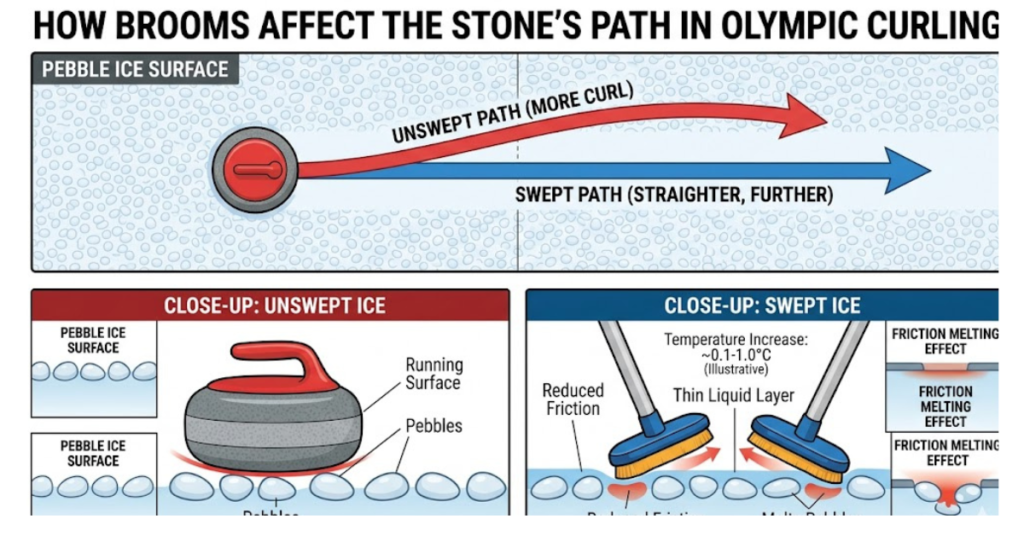

If you’ve ever watched Olympic curling, you’ve probably wondered how do brooms affect the stone’s path in Olympic curling? The intense sweeping looks dramatic, but it’s far more than just for show. In reality, sweeping is a critical technique that influences speed, distance, and even direction of the stone as it glides across the ice.
Understanding how curling brooms work helps reveal the strategy behind one of the Winter Olympics’ most fascinating sports. In this article, we’ll break down the science, technique, and tactics behind sweeping—so you can appreciate every slide, curl, and perfectly placed shot.
The Basics of Curling and Stone Movement
Before diving into sweeping, it helps to understand how a curling stone behaves.
- A curling stone weighs about 44 pounds 20 kg
- It travels across a pebbled ice surface
- The stone naturally curls (curves) as it slows down
- Friction between the stone and ice determines its path
Without sweeping, the stone follows a predictable arc. But sweeping changes that trajectory—sometimes dramatically.
How Do Brooms Affect the Stone’s Path in Olympic Curling?
Sweeping with a broom affects the stone in three major ways:
1. Reduces Friction
When curlers sweep, they heat the ice slightly and smooth out the pebbled surface. This reduces friction, allowing the stone to:
- Travel farther
- Maintain higher speed
- Stay on a straighter path
Even a small reduction in friction can change the stone’s final position by several feet.
2. Controls the Curl Direction
One of the biggest impacts of sweeping is reducing the stone’s curl.
- More sweeping = less curl
- Less sweeping = more curve
This allows players to “hold the line” and prevent the stone from drifting too far sideways.
3. Fine-Tunes Shot Accuracy
Elite curlers use sweeping to make micro-adjustments. This includes:
- Extending a draw shot
- Preventing a takeout from curling too much
- Nudging the stone into the scoring area (house)
The Science Behind Sweeping in Curling
Sweeping works due to physics:
Heat Generation
- Sweeping raises ice temperature by a few degrees
- This creates a thin water film
- The stone glides more easily
Ice Pebble Modification
Curling ice isn’t flat. It’s pebbled with small bumps. Sweeping:
- Flattens the pebble tops
- Creates smoother glide path
- Reduces unpredictable movement
Rotational Effect
Curling stones rotate slowly. Sweeping influences how much the rotation affects the curve, helping control direction.
Types of Sweeping Techniques Used in Olympic Curling
Different sweeping styles produce different results:
Power Sweeping
- Fast, aggressive strokes
- Maximum friction reduction
- Used to extend distance
Directional Sweeping
- Sweepers focus on one side of the stone
- Helps control curl direction
- Often used for precise shots
Light Sweeping
- Gentle strokes
- Minor adjustments
- Used near the end of the shot
Why Team Communication Matters
Sweeping isn’t random—it’s coordinated. Teams constantly communicate:
- Skip calls line and weight
- Sweepers judge speed
- Adjustments happen instantly
You’ll often hear commands like:
- “Hard!” (sweep aggressively)
- “Whoa!” (stop sweeping)
- “Line’s good!” (hold direction)
This teamwork directly affects the stone’s path.
Evolution of Curling Brooms
Modern Olympic curling brooms are designed for performance:
- Carbon fiber handles (lightweight)
- Synthetic fabric heads
- Specialized directional fabrics
Equipment rules were updated in recent years to prevent excessive directional sweeping advantages, ensuring fair play.
Key Factors That Influence Sweeping Effectiveness
Several variables determine how much sweeping changes the stone’s path:
- Sweeper strength
- Ice conditions
- Stone rotation
- Timing of sweeping
- Brush head material
Even tiny differences can affect Olympic-level outcomes.
Common Situations Where Sweeping Changes the Shot
Sweeping is especially important during:
- Draw shots to the house
- Guard placement
- Takeouts requiring precision
- Freeze shots near other stones
- Last-stone advantage plays
These moments often decide the match.
FAQs About How Brooms Affect the Stone’s Path in Olympic Curling
Does sweeping actually melt the ice?
Yes, slightly. Sweeping creates minimal heat, forming a thin water layer that reduces friction.
Can sweeping change the direction of the stone?
Yes. Directional sweeping can reduce curl and help guide the stone straighter.
Do curlers sweep the whole way?
Not always. Sweeping is used strategically based on speed and trajectory.
Why do two players sweep?
Two sweepers increase friction reduction and provide better control.
Are curling brooms regulated?
Yes. Olympic regulations control broom materials to maintain fairness.
Conclusion
So, how do brooms affect the stone’s path in Olympic curling? Sweeping reduces friction, controls curl, and fine-tunes accuracy—making it one of the most important skills in the sport. What looks like frantic brushing is actually a carefully calculated strategy backed by physics, teamwork, and precision.
Next time you watch Olympic curling, pay attention to the sweepers. Their effort could be the difference between a perfect shot and a missed opportunity.
If you’re interested in learning more, explore topics like curling scoring rules, curling strategy, or the physics of curling stones for deeper insight into this fascinating sport.