
Have you ever paused mid-planning and wondered, how many weeks in a year actually exist? Whether you’re organizing your work schedule, budgeting, or mapping out goals, understanding how weeks fit into a year makes life surprisingly easier.
In simple terms, a year doesn’t divide perfectly into whole weeks — and that’s where things get interesting. In this guide, we’ll break it down clearly, explore leap years, explain leftover days, and show practical examples you can use right away.
How Many Weeks in a Year? (The Short Answer)
A standard year has:
- 365 days
- 7 days in a week
So the calculation looks like this:
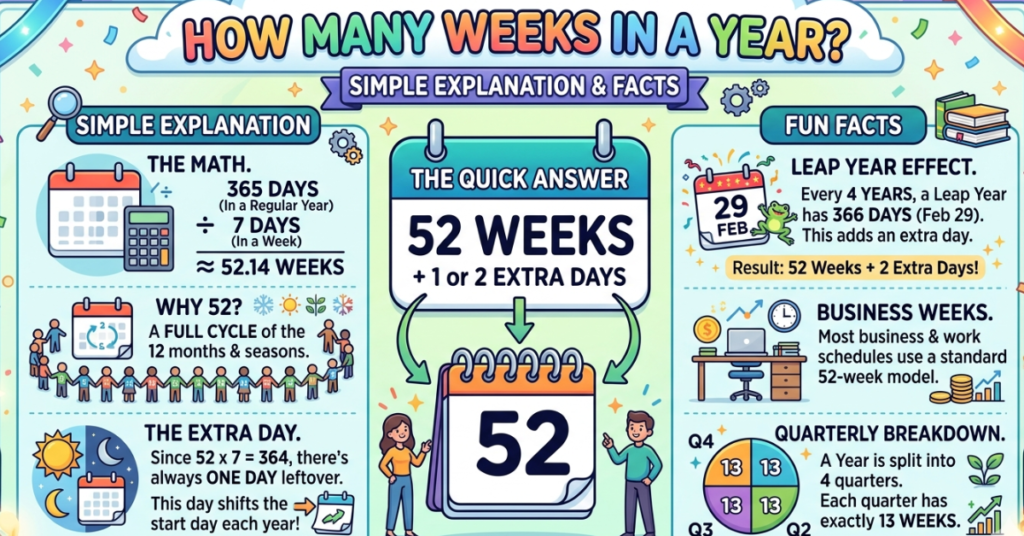
365 ÷ 7 = 52 weeks and 1 day
That means there are 52 full weeks in a year, plus 1 extra day.
This is why calendars don’t end on the same weekday every year.
How Many Weeks in a Leap Year?
A leap year has 366 days instead of 365.
366 ÷ 7 = 52 weeks and 2 days
So in a leap year, you get:
- 52 weeks
- 2 extra days
This extra day is February 29, added every four years to keep our calendar aligned with Earth’s orbit.
Why Doesn’t a Year Have Exactly 52 Weeks?
Here’s the key idea:
- 52 weeks = 364 days
- A regular year = 365 days
- Leap year = 366 days
So:
- Regular year → 52 weeks + 1 day
- Leap year → 52 weeks + 2 days
That leftover day is what shifts holidays and weekdays each year.
Weeks in a Year vs Work Weeks
Sometimes people asking how many weeks in a year actually mean work weeks. Here’s the difference:
Total Weeks
- 52 weeks total in a year
Typical Work Weeks
If you subtract vacation time:
- 52 weeks
- minus 2 weeks vacation
- minus 10 public holidays (approx.)
You may end up with around 48–50 working weeks per year.
This is useful for:
- Salary calculations
- Project timelines
- Business planning
How Many Weeks in a Year for Payroll?
Many companies use 52 weeks for payroll calculations. For example:
- Weekly salary → paid 52 times
- Biweekly salary → paid 26 times
- Monthly salary → paid 12 times
This standardized approach simplifies budgeting and accounting.
Weeks in a Year by Calendar System
Different systems count weeks differently:
ISO Week Date System
- Some years have 53 weeks
- This happens when:
- January 1 falls on a Thursday, OR
- It’s a leap year starting on Wednesday
Examples:
- 2015 → 53 weeks
- 2020 → 53 weeks
So technically:
- Most years = 52 weeks
- Some years = 52 weeks + 1 extra week (ISO)
Quick Reference Table
| Year Type | Days | Weeks | Extra Days |
| Regular Year | 365 | 52 | 1 |
| Leap Year | 366 | 52 | 2 |
| ISO Long Year | 365/366 | 53 | 0 |
Practical Examples
Understanding how many weeks in a year helps with:
- Setting yearly goals
- Planning fitness programs
- School schedules
- Budgeting monthly vs weekly
- Project management timelines
Example:
If you save $50 per week:
- $50 × 52 weeks = $2,600 per year
Small weekly habits add up fast.
FAQs About How Many Weeks in a Year
How many weeks are exactly in a year?
There are 52 full weeks in a standard year, plus 1 extra day (or 2 in a leap year).
Are there ever 53 weeks in a year?
Yes, using the ISO calendar, some years have 53 weeks depending on how the days fall.
How many weeks in 365 days?
365 days equals 52 weeks and 1 day.
How many weeks in 366 days?
366 days equals 52 weeks and 2 days.
How many working weeks in a year?
Typically 48–50 working weeks, depending on vacation and holidays.
Why do calendars shift every year?
Because the year has extra days beyond 52 weeks, weekdays move forward annually.
Conclusion
So, how many weeks in a year? The simple answer is 52 weeks, but the full picture includes one or two extra days — and occasionally a 53rd week in certain calendar systems. Understanding this small detail can make a big difference when planning schedules, finances, or long-term goals.
Now that you know how weeks fit into a year, try applying it to something practical — like setting 52 weekly goals or tracking progress week by week. Small steps, taken consistently, really do add up.