
Understanding how has the study of mitosis affected scientists’ knowledge of cancer? has been one of the most important breakthroughs in modern biology. At its core, cancer is a disease of uncontrolled cell division—and mitosis is the exact process responsible for cell division. By studying mitosis, scientists have uncovered how normal cells become cancerous, why tumors grow, and how new treatments can stop cancer from spreading.
In this article, we’ll explore how mitosis research transformed cancer science, improved diagnostics, and led to life-saving therapies.
What Is Mitosis? Quick Overview
Mitosis is the process by which a single cell divides into two identical daughter cells. This process is essential for:
- Growth and development
- Tissue repair
- Replacement of damaged cells
- Maintaining genetic stability
During mitosis, chromosomes duplicate and separate carefully. When this process goes wrong, cells may divide uncontrollably — a hallmark of cancer.
How Has the Studys of Mitosiss Affected Scientists’ Knowledges of Cancer?
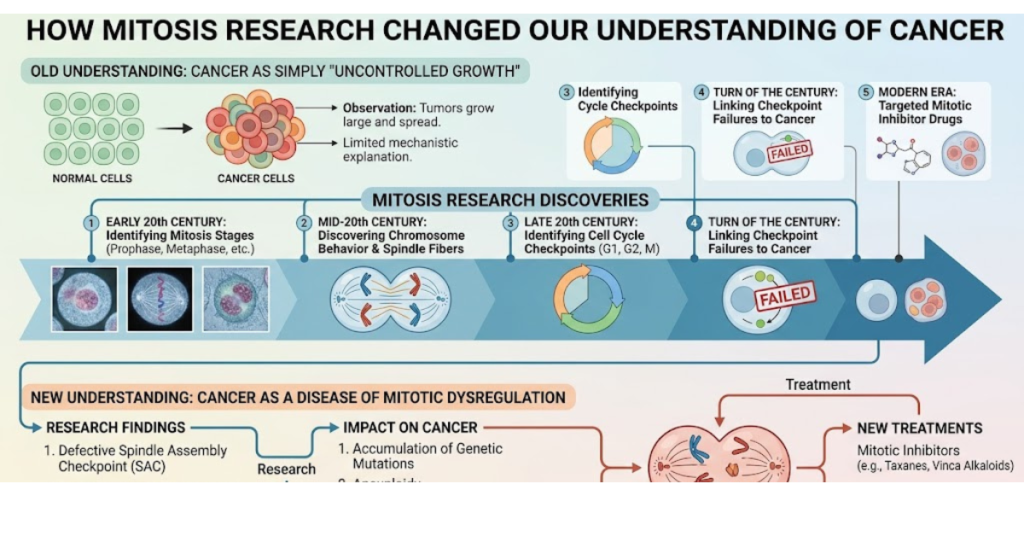
Scientists realized that cancer develops when mitosis loses control. By studying each stage of mitosis, researchers discovered:
- Cancer cells divide faster than normal cells
- Genetic mutations disrupt cell cycle checkpoints
- Abnormal chromosome numbers appear in tumors
- Faulty mitotic spindle formation leads to instability
This knowledge helped scientists understand that cancer is not just a disease but a disorder of cell division regulation.
The Role of Cell Cycle Checkpoints in Cancer
Why Checkpoints Matter
During mitosis, cells pass through checkpoints to ensure DNA is correct before dividing. These checkpoints act like quality control systems.
When scientists studied mitosis closely, they discovered:
- Cancer cells often bypass these checkpoints
- Tumor suppressor genes (like p53) stop working
- Damaged DNA gets copied and spread
Key Discovery
The breakdown of checkpoint control explains how tumors grow quickly and why cancer cells accumulate mutations over time.
Chromosomal Abnormalities and Tumor Growth
One major insight from mitosis research is chromosomal instability.
Scientists observed that cancer cells often have:
- Extra chromosomes
- Missing chromosomes
- Broken chromosome segments
- Uneven distribution during mitosis
These abnormalities lead to:
- Rapid tumor evolution
- Drug resistance
- Aggressive cancer behavior
Without studying mitosis, this connection would have remained unclear.
How Mitosis Research Led to Cancer Treatments
The study of mitosis didn’t just explain cancer — it also helped scientists fight it. Many chemotherapy drugs specifically target dividing cells.
Examples of Mitosis-Targeting Treatments
- Taxanes (Paclitaxel) – Block spindle formation
- Vinca alkaloids – Prevent chromosome separation
- CDK inhibitors – Stop cell cycle progression
- Aurora kinase inhibitors – Disrupt mitotic signaling
These treatments slow or stop cancer cell division while sparing most normal cells.
Mitosis and Early Cancer Detection
Understanding mitosis also improved diagnostic tools. Doctors now look for:
- High mitotic index (number of dividing cells)
- Abnormal chromosome patterns
- Uncontrolled proliferation markers
- Cell cycle protein expression
These indicators help determine:
- Cancer stage
- Tumor aggressiveness
- Best treatment options
Key Ways Mitosis Research Advanced Cancer Knowledge
Here’s a quick summary:
- Identified uncontrolled cell division as cancer’s root cause
- Explained tumor growth mechanisms
- Revealed chromosomal instability in cancer cells
- Led to targeted chemotherapy drugs
- Improved cancer diagnosis and prognosis
- Helped develop personalized medicine approaches
Why Cancer Cells Divide Differently
Cancer cells behave differently during mitosis because:
- They ignore stop signals
- They divide even with damaged DNA
- They complete mitosis faster
- They produce genetically unstable cells
This explains why tumors grow rapidly and spread throughout the body.
Future Research: What Scientists Are Exploring Now
Current studies of mitosis and cancer focus on:
- Targeted therapies with fewer side effects
- Immunotherapy combined with mitotic inhibitors
- Precision medicine based on cell cycle mutations
- AI-driven analysis of mitotic abnormalities
These innovations may lead to more effective cancer treatments in the coming years.
READ ALSO<<<How Wide Is a Twin Bed? Exact Dimensions & Buying Guide
FAQs
1. Why is mitosis important in understanding cancer?
Mitosis is the process of cell division. Cancer occurs when mitosis becomes uncontrolled, causing cells to multiply rapidly.
2. How does abnormal mitosis lead to tumors?
Errors during mitosis cause mutations and chromosomal instability, leading to uncontrolled growth and tumor formation.
3. Do cancer treatments target mitosis?
Yes. Many chemotherapy drugs specifically target dividing cells by disrupting stages of mitosis.
4. What is the mitotic index in cancer?
The mitotic index measures how many cells are dividing. A high mitotic index often indicates aggressive cancer.
5. Can studying mitosis help prevent cancer?
Yes. Understanding cell cycle control helps scientists develop drugs that stop abnormal cell division early.
Conclusion
So, how has the study of mitosis affected scientists’ knowledge of cancer? In short, it changed everything. By uncovering how cells divide — and what happens when that process fails — researchers identified the root causes of tumor growth, developed targeted therapies, and improved early detection methods.