
Have you ever paused mid-sentence wondering whether to write signer or signor? You’re not alone. These two words may look similar, but they come from entirely different linguistic backgrounds and serve very different purposes. Understanding the distinction between signer or signor is essential for clear communication—especially in formal writing, legal contexts, or when using Italian terms correctly.
In this guide, we’ll break down their meanings, origins, and correct usage with practical examples so you’ll never mix them up again.
Signer or Signor: What’s the Difference?
At first glance, signer and signor differ by just one letter. But that small change creates a big difference in meaning.
- Signer → An English word related to signing documents
- Signor → An Italian title equivalent to “Mr.”
Let’s explore each one in detail.
What Does “Signer” Mean?
Definition of Signer
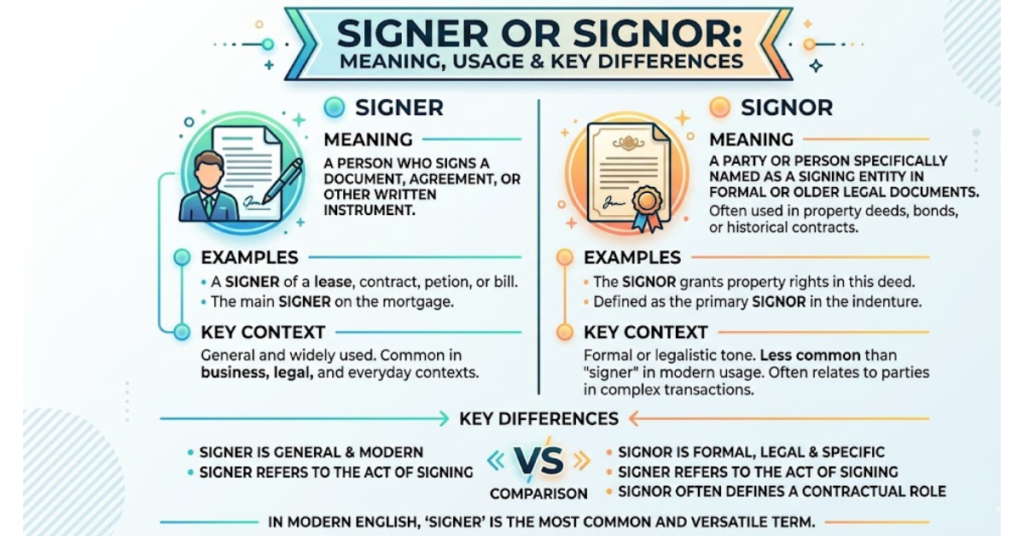
A signer is a person who signs a document, agreement, or contract. This term is commonly used in legal, business, and formal contexts.
Common Uses of Signer
- Legal documents (contracts, agreements)
- Financial paperwork
- Official forms
Examples
- The signer must provide valid identification before signing the contract.
- Each signer is responsible for reviewing the document carefully.
Key Points
- It’s an English noun
- Used in formal or professional settings
- Refers to an action (signing)
What Does “Signor” Mean?
Definition of Signor
Signor is an Italian word that translates to “Mr.” in English. It is a polite title used before a man’s name.
Common Uses of Signor
- Addressing Italian men formally
- In literature or cultural references
- When speaking Italian or referencing Italian etiquette
Examples
- Signor Rossi will join us shortly.
- Thank you, Signor, for your assistance.
Key Points
- It’s borrowed from Italian
- Used as a title of respect
- Not related to signing documents
Signer vs Signor: Side-by-Side Comparison
| Feature | Signer | Signor |
| Language | English | Italian |
| Meaning | One who signs documents | A respectful title (Mr.) |
| Usage Context | Legal, business | Social, cultural |
| Example | “The signer agreed to terms.” | “Signor Bianchi is here.” |
Common Mistakes to Avoid
Even experienced writers sometimes confuse signer or signor. Here are a few pitfalls:
1. Using “Signor” in Legal Contexts
Incorrect: The signor must approve the contract.
Correct: The signer must approve the contract.
2. Using “Signer” as a Title
Incorrect: Signer Marco will attend the meeting.
Correct: Signor Marco will attend the meeting.
3. Misspelling Due to Similarity
Because they sound alike, spell-check won’t always catch mistakes. Always double-check context.
When Should You Use Signer or Signor?
Use “Signer” When:
- Referring to someone signing documents
- Writing legal or formal content
- Discussing agreements or contracts
Use “Signor” When:
- Addressing or referring to an Italian man
- Writing about Italian culture or language
- Using formal titles in Italian contexts
Why This Confusion Happens
The confusion between signer or signor often comes down to:
- Similar pronunciation
- Nearly identical spelling
- Lack of familiarity with Italian terms
However, remembering their roots makes it easier:
- Signer → “sign” (English verb)
- Signor → Italian honorific
Quick Memory Trick
Here’s a simple way to remember:
- Signer = Signature (both relate to signing)
- Signor = Señor-like (a title for a man)
FAQs About Signer or Signor
1. Is “signor” used in English?
Yes, but mainly in contexts involving Italian language, culture, or names.
2. Can “signer” be used as a title?
No. “Signer” refers to a role, not a title of respect.
3. What is the feminine form of “signor”?
The feminine equivalent is “signora” (Mrs.) or “signorina” (Miss).
4. Are “signer” and “signor” pronounced the same?
They are similar but not identical. “Signor” has an Italian pronunciation: seen-yor.
5. Which is more commonly used?
“Signer” is more common in everyday English, especially in legal or business settings.
Conclusion
Understanding the difference between signer or signor is simpler than it seems once you know their origins and contexts. A signer is someone who signs documents, while signor is a respectful Italian title for a man. Mixing them up can lead to confusion—especially in formal writing—so it’s worth getting right.
Next time you encounter these words, you’ll know exactly which one to use. If you’re interested in improving your grammar and vocabulary further, explore related language guides to sharpen your writing skills even more.