
If you’ve ever typed laser vs lazer and paused for a second wondering which one is correct, you’re not alone. It’s one of those spelling questions that shows up in searches surprisingly often—and for good reason. The word is used everywhere, from science labs to hair removal clinics to sci-fi movies.
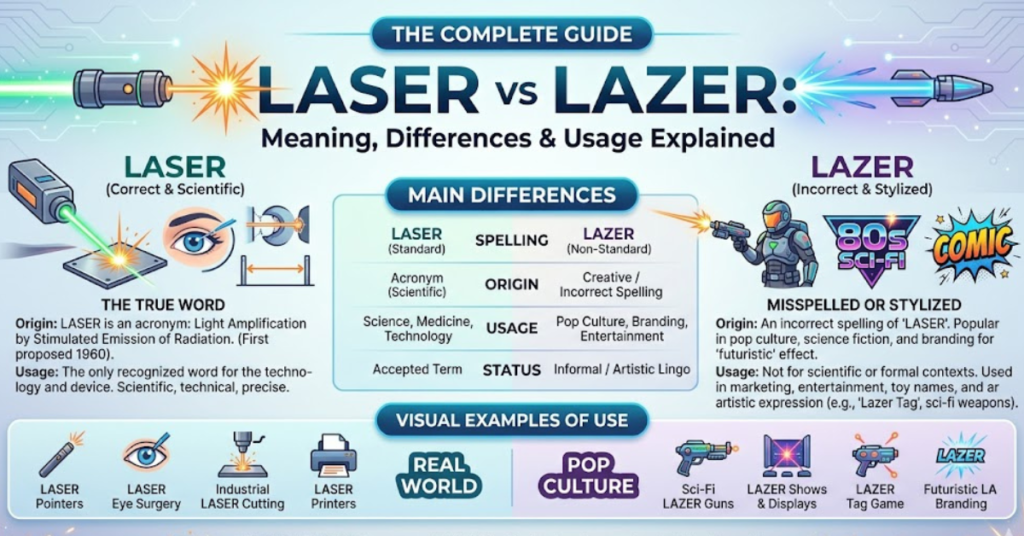
Here’s the simple truth: “laser” is the correct spelling, while “lazer” is a common misspelling or stylistic variation.
But there’s more to the story than just spelling.
What Does “Laser” Actually Mean?
The word laser stands for:
Light Amplification by Stimulated Emission of Radiation
In simple terms, a laser is a device that produces a highly focused beam of light. This light is powerful, precise, and used in many industries.
Common uses of lasers include:
- Medical procedures (eye surgery, skin treatments)
- Hair removal (laser hair removal)
- Industrial cutting and welding
- Barcode scanners
- Fiber-optic communication
- Military and research applications
The keyword here is precision—laser technology is all about controlled, concentrated energy.
Laser vs Lazer: Why Do People Spell It “Lazer”?
Even though laser is the correct spelling, “lazer” still appears frequently online, in branding, and in pop culture.
Reasons for the confusion:
- Pronunciation: “Laser” sounds like it could be spelled “lazer”
- Branding choices: Companies sometimes use “lazer” to look modern or edgy
- Pop culture influence: Video games, movies, and music often stylize it creatively
- Typo habits: Many users simply type it the way it sounds
However, in scientific, medical, and academic contexts, only laser is considered correct.
Is “Lazer” Ever Correct?
Technically, “lazer” is not a scientific term. But it can still appear in:
- Brand names (e.g., “Lazer tag” style products)
- Entertainment titles
- Informal writing or slang
So while it exists in everyday language, it does not replace the correct term.
Laser Technology: How It Works
Understanding the difference between laser vs lazer also means understanding the science behind it.
Step-by-step basics:
- Energy is applied to atoms inside a medium (gas, crystal, or liquid)
- Atoms become excited and release photons
- Photons bounce between mirrors, amplifying light
- A concentrated beam of light is released through one end
This process creates a beam that is:
- Highly focused
- Single-colored (monochromatic)
- Directional
- Powerful over long distances
Types of Lasers You Should Know
Lasers come in different forms depending on their use:
1. Gas Lasers
Used in industrial cutting and scientific research.
2. Solid-State Lasers
Common in medical tools and military systems.
3. Semiconductor Lasers
Found in barcode scanners and fiber optics.
4. Fiber Lasers
Used in telecommunications and precision manufacturing.
Laser vs Lazer in SEO and Writing
- Use “laser” for accuracy and ranking
- Avoid overusing “lazer” unless referencing branding or stylized names
- Include both terms if targeting search queries
LSI keywords you’ll often see:
- laser technology
- laser treatment
- laser beam
- laser cutting
- laser therapy
- laser equipment
Common Mistakes People Make
Here are a few frequent errors related to laser vs lazer:
- Thinking “lazer” is an alternative spelling
- Using “lazer” in academic writing
- Confusing laser with other light technologies
- Overgeneralizing laser applications
FAQs About Laser vs Lazer
1. Is it laser or lazer?
The correct spelling is laser. “Lazer” is informal or incorrect in scientific usage.
2. Why do people write lazer instead of laser?
Because of pronunciation and branding choices, especially in entertainment and marketing.
3. Does lazer mean something different?
No. It is not a technical or scientific term.
4. What does LASER stand for?
It stands for Light Amplification by Stimulated Emission of Radiation.
5. Where are lasers used in real life?
Lasers are used in medicine, industry, communication, security, and entertainment.
Conclusion
When comparing laser vs lazer, the answer is simple but important: laser is the correct and scientifically accepted spelling, while “lazer” is mostly a stylistic or informal variation.
Understanding this difference helps in writing accurately, especially in technical, academic, or SEO-focused content. Beyond spelling, lasers themselves are one of the most important technologies in modern science, powering everything from medical breakthroughs to global communication systems.