
You’ve probably heard the phrase how are you doing countless times in daily conversations. It’s simple, friendly, and widely used — yet many people still wonder about its exact meaning, when to use it, and how it translates into other languages.
This article explains the how are you doing meaning, shows natural responses, and covers translations such as how are you doing in Spanish, French, and German. By the end, you’ll confidently use it in casual chats, professional settings, and even multilingual conversations.
What Does This Phrase Mean?
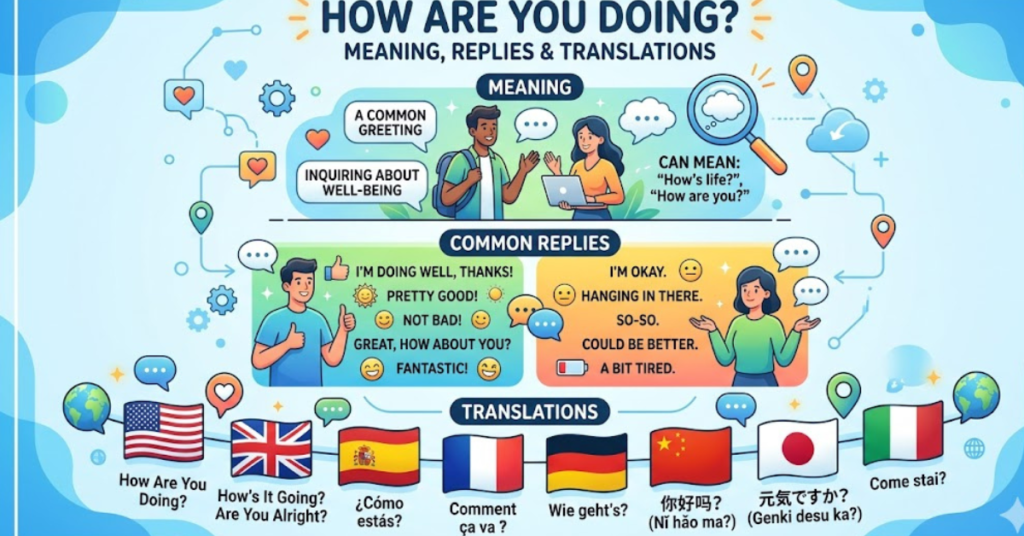
This common greeting is a polite way to ask about someone’s well-being. Depending on the situation, it can refer to:
- General mood
- Physical health
- Daily activities
- Casual social greeting
Often, it’s used as a friendly opener rather than a deep question. For example:
- “Hi, how are you doing?”
- “Good morning — how are you doing today?”
- “Hey, I heard about your new job. How are things going?”
How Are You Doing Today vs. Standard Greeting
Adding today makes the question more specific and thoughtful. It suggests interest in the person’s current situation rather than a routine greeting.
Examples:
- “How are you doing today?” — more personal
- “How are things?” — more casual
This variation is common in workplaces, customer service, and polite conversations.
Natural Responses You Can Use
Here are some easy replies:
Casual Responses
- I’m doing well, thanks!
- Pretty good — you?
- Not bad.
Positive Responses
- Great, thanks for asking!
- I’m having a good day.
Neutral Responses
- I’m okay.
- Just busy, but good.
Professional Responses
- I’m doing well, thank you. And yourself?
- All good on my end.
How Are You Doing in Spanish 🇪🇸
The most common translations include:
- ¿Cómo estás? (informal)
- ¿Cómo está usted? (formal)
Other alternatives:
- ¿Cómo te va?
- ¿Qué tal?
Example:
- Hola, ¿cómo estás?
These phrases are widely used in everyday Spanish conversations.
In French 🇫🇷
In French, you can say:
- Comment ça va ? (informal)
- Comment allez-vous ? (formal)
Example:
- Bonjour, comment ça va ?
Both are standard greetings used in France and other French-speaking regions.
Hi in German 🇩🇪
To greet someone in German, you can use:
- Hallo, wie geht es dir? (informal)
- Hallo, wie geht es Ihnen? (formal)
These are common expressions in both casual and professional settings.
Similar Expressions You Can Use
To keep conversations natural, try variations like:
- How’s it going?
- How are things?
- What’s up?
- How have you been?
- How’s everything?
These alternatives carry similar meanings and improve conversational variety.
When Should You Use This Greeting?
You can use it in many situations:
- Meeting someone casually
- Starting an email
- Checking on a friend
- Workplace conversations
- Customer service interactions
It’s flexible and works almost anywhere.
FAQs
What is the meaning of this phrase?
It’s a friendly way to ask about someone’s well-being or current situation.
How do you say it in Spanish?
You can say ¿Cómo estás? or ¿Qué tal?
How is it said in French?
Use Comment ça va ?
Is it formal or informal?
It’s mostly informal but acceptable in semi-formal settings.
What’s the difference between “How are you” and this version?
The longer version sounds more conversational and relaxed.
Conclusion
This simple greeting plays an important role in everyday communication. Understanding its meaning, knowing how to respond, and learning translations in Spanish, French, and German can help you connect more naturally.
Use it casually with friends, professionally at work, or when practicing new languages. Small conversational phrases like this can make interactions warmer and more engaging.