
Have you ever paused while writing and wondered whether it should be stoped or stopped? You’re definitely not alone. English spelling rules can be tricky, especially when verbs change form.
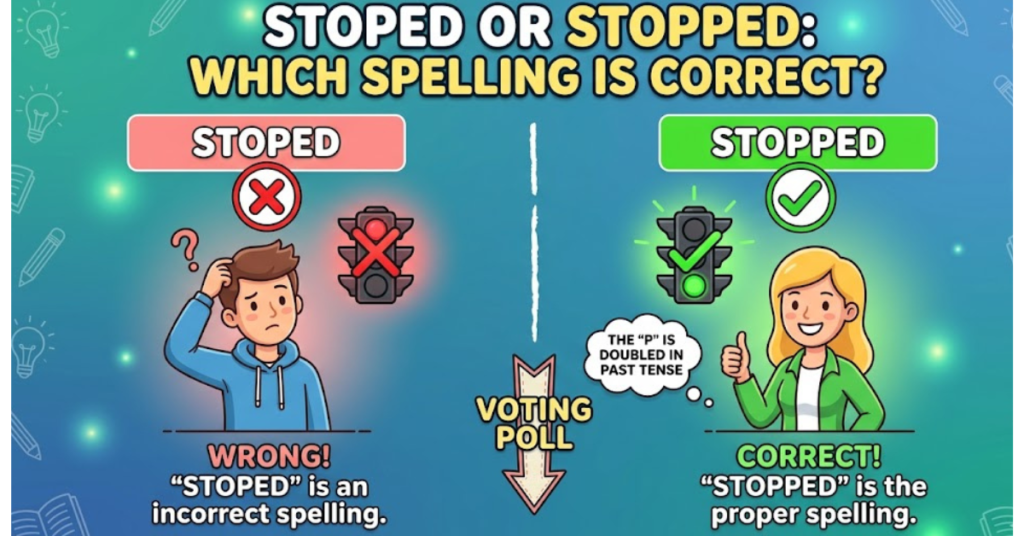
The good news is that the answer is simple: “stopped” is correct, while “stoped” is incorrect in standard English. Many people make this mistake because spelling patterns aren’t always obvious.
In this guide, we’ll break down the difference between stoped or stopped, explain the grammar rule behind it, and show you easy examples so you never get confused again.
Stoped or Stopped: The Correct Spelling
The correct past tense and past participle of the verb “stop” is stopped.
Correct:
- I stopped at the red light.
- She stopped talking suddenly.
- They stopped working at 6 PM.
Incorrect:
- I stoped at the red light.
- She stoped talking suddenly.
The word “stoped” is considered a spelling mistake in modern English writing.
Why Is It “Stopped” and Not “Stoped”?
The reason comes from a common English grammar rule called the double consonant rule.
The Rule
When a verb:
- Has one syllable
- Ends in a consonant-vowel-consonant (CVC) pattern
- The final syllable is stressed
—you usually double the final consonant before adding -ed or -ing.
Example with “stop”
- Base verb: stop
- Pattern: consonant (s) + vowel (o) + consonant (p)
So:
- stop + ed = stopped
- stop + ing = stopping
Not:
- stoped
- stoping
This same rule applies to many similar words.
Examples of Similar Words
Here are other verbs that follow the same spelling pattern:
| Base Verb | Correct Past Form |
| stop | stopped |
| plan | planned |
| shop | shopped |
| drop | dropped |
| clap | clapped |
Notice how the final consonant is doubled before adding -ed.
Common Confusion Around Stoped or Stopped
Many learners think adding -ed should be straightforward:
- walk → walked
- jump → jumped
So naturally, they assume:
- stop → stoped
But because “stop” follows the consonant doubling rule, the spelling changes to stopped.
This is one of the most common English spelling mistakes, especially for students, ESL learners, and even native speakers typing quickly.
Is “Stoped” Ever Correct?
In standard English grammar, no—“stoped” is not correct.
However, you might see it:
- in old texts
- as a typo
- in informal online writing
- from non-native English speakers
Still, in professional writing, academic work, emails, and SEO content, you should always use stopped.
How to Remember the Correct Spelling
A simple trick:
Short word + short vowel = double the final consonant
Think of:
- hop → hopped
- stop → stopped
- drop → dropped
This quick memory tip helps avoid the stoped or stopped confusion instantly.
Stopped in Different Tenses
Let’s look at how “stop” changes:
Present Tense
- I stop
- She stops
Past Tense
- I stopped
- They stopped
Present Participle
- stopping
Past Participle
- has stopped
Every correct form uses the doubled P.
Examples in Everyday Sentences
Here are practical examples using stopped correctly:
At Work
- The meeting stopped because of a power outage.
While Driving
- He stopped the car near the station.
In Conversation
- She suddenly stopped laughing.
In Business
- Sales stopped growing last quarter.
Using examples like these helps reinforce the correct spelling naturally.
Quick Grammar Checklist
Before writing, ask yourself:
Is the base verb short?
Does it end in consonant-vowel-consonant?
Is it one syllable?
If yes, double the last consonant.
That’s why stopped wins over stoped every time.
Common Mistakes to Avoid
Here are mistakes people often make:
Wrong:
- stoped
- stoping
- planed (when meaning planned)
Right:
- stopped
- stopping
- planned
Even small spelling mistakes can affect credibility, especially in resumes, blog posts, and formal communication.
Why Correct Spelling Matters for SEO and Writing
Using the correct form—stopped instead of stoped—matters because:
- it improves readability
- it builds trust with readers
- it helps search engines understand your content
- it prevents grammar-related ranking issues
Even one spelling mistake can make professional content look less reliable.
That’s why understanding stoped or stopped is more important than it seems.
FAQs About Stoped or Stopped
FAQ 1: Is stoped a real word?
No, stoped is not considered correct in standard modern English. The correct spelling is stopped.
FAQ 2: Why do we double the P in stopped?
Because “stop” follows the consonant-vowel-consonant pattern, English grammar requires doubling the final consonant before adding -ed.
FAQ 3: Is it stopping or stoping?
The correct spelling is stopping, not stoping.
FAQ 4: What is the past tense of stop?
The past tense of “stop” is stopped.
Example:
- He stopped running.
FAQ 5: Why do people write stoped?
Usually because they apply the simple “add -ed” rule without remembering the consonant doubling rule.
Conclusion
So, when it comes to stoped or stopped, the correct answer is clear: stopped is the right spelling, and stoped is incorrect.
The reason is simple—English grammar requires doubling the final consonant for short verbs like “stop” before adding -ed or -ing.
Remember:
- stop → stopped
- stop → stopping
Getting small spelling details right can make a big difference in writing quality, SEO performance, and professional communication.