
Ever paused mid-sentence wondering whether it’s flies or flys? You’re not alone. This tiny spelling dilemma trips up writers, students, and even seasoned professionals. The confusion often pops up in phrases like time flies or flys or the plane flies or flys, leaving people second-guessing themselves.
In this guide, we’ll clear things up in plain English. You’ll learn the difference, understand why one form is correct, and see real examples so you never hesitate again.
Flies or Flys: What’s the Correct Spelling?
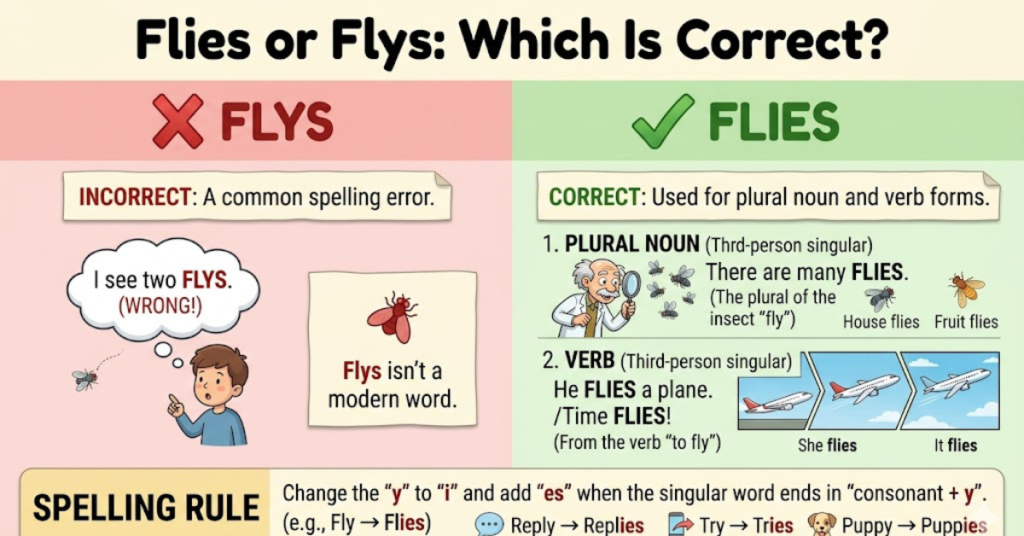
Let’s settle it right away: “flies” is almost always correct, while “flys” is rarely used and usually incorrect.
Why “Flies” Is Correct
“Flies” is the standard third-person singular form of the verb fly. It follows a common English grammar rule:
When a verb ends in a consonant + “y,” the “y” changes to “ies.”
Examples:
- She flies to Dubai every month.
- The airplane flies at high altitude.
- Time flies when you’re having fun.
When (If Ever) Is “Flys” Used?
Technically, “flys” can appear as a proper noun or surname, but in everyday grammar, it’s not correct.
So if you’re asking:
- is it flies or flys? → It’s flies
- flies or flys verb? → The correct verb form is flies
Common Phrases: Flies vs Flys in Real Life
Let’s look at phrases people often search for and clear up the confusion.
Time Flies or Flys?
The correct phrase is: time flies
This is a well-known idiom meaning time passes quickly.
Correct examples:
- Time flies during holidays.
- Crazy how time flies when you’re busy.
- My, how time flies!
So if you’re wondering:
- is it time flies or flys? → time flies
- time flies or flys grammar? → “flies” is grammatically correct
The Plane Flies or Flys?
Always: the plane flies
Examples:
- The plane flies across the Atlantic.
- An airplane flies using lift and thrust.
Whether you say:
- a plane flies or flys
- the airplane flies or flys
The answer remains the same: flies is correct.
He/She Flies or Flys?
Use flies for both.
Examples:
- He flies drones professionally.
- She flies to London often.
So:
- he flies or flys? → flies
- she flies or flys? → flies
Why the Confusion Happens
English spelling rules aren’t always intuitive. The confusion between flies or flys usually comes from:
- Overgeneralizing rules (like just adding “s” to verbs)
- Not remembering the “y → ies” rule
- Seeing rare or incorrect usage online
Quick Grammar Rule to Remember
Here’s a simple way to lock it in:
Change “y” to “ies” when:
- The verb ends in a consonant + y
- You’re using third-person singular (he/she/it)
Examples:
- Fly → flies
- Try → tries
- Cry → cries
Flies: More Than Just a Verb
Interestingly, “flies” can also be a noun.
As a noun:
- Refers to the insect
- Refers to parts of clothing (like a zipper area)
Example:
- Flies are common in summer. (flies or flys insect → flies)
Quick Comparison Table
| Usage Type | Correct Form | Example |
| Verb (he/she/it) | flies | She flies daily |
| Phrase | flies | Time flies fast |
| Airplane context | flies | The plane flies high |
| Insect plural | flies | Flies are annoying |
| Incorrect form | flys | Not standard |
FAQs
1. Is it “flies or flys” correct?
“Flies” is correct in standard English. “Flys” is almost never used.
2. Is it “time flies or flys”?
The correct phrase is time flies.
3. Why do people write “flys”?
It’s usually a spelling mistake or misunderstanding of grammar rules.
4. How time flies or flys—which is right?
The correct form is how time flies.
5. Is “flies” a verb or noun?
Both! It can be a verb (she flies) and a noun (insects called flies).
6. What about “flies or flys by”?
The correct phrase is flies by.
Conclusion
When it comes to flies or flys, the answer is simple: “flies” is the correct form in almost every situation. Whether you’re writing time flies, describing how a plane flies, or talking about insects, “flies” is your go-to word.
The trick is remembering the grammar rule: verbs ending in “y” often change to “ies” in the third person. Once that clicks, the confusion disappears.
If you want to sharpen your writing further, keep exploring common grammar mix-ups like this—they’re small details that make a big difference.