
Ever paused mid-sentence wondering whether it’s scarry or scary? You’re not alone. This common spelling mix-up trips up writers of all levels, especially because both versions look plausible at a glance. But here’s the truth: only one of them is correct.
In this guide, we’ll break down the scarry or scary meaning, explain why the confusion happens, and show you exactly how to use the correct word with confidence. By the end, you’ll never second-guess it again.
Scarry or Scary: What’s the Difference?
Let’s clear this up right away:
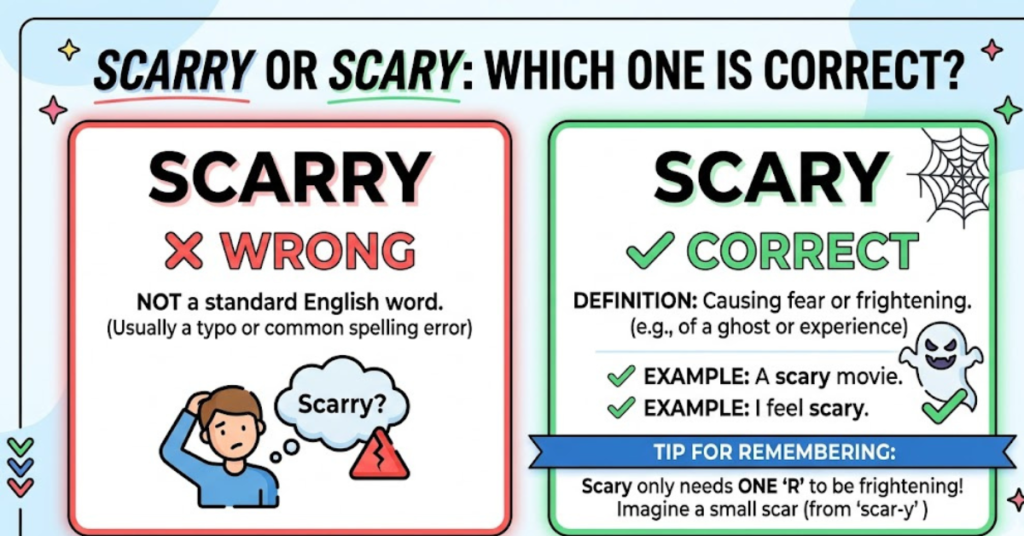
- Scary – Correct spelling
- Scarry – Incorrect spelling (a common typo)
What Does “Scary” Mean?
The word scary is an adjective used to describe something that causes fear or makes you feel frightened.
Examples:
- That movie was really scary.
- I heard a scary noise outside last night.
- Roller coasters can be scary for some people.
What About “Scarry”?
“Scarry” isn’t a recognized English word. It usually appears due to:
- Typing errors
- Confusion with similar words like carry or marry
- Misunderstanding spelling rules
Why Do People Confuse Scarry or Scary?
The confusion between scarry or scary meaning mostly comes down to spelling patterns in English.
1. Double Consonant Confusion
Many English words use double letters (like running or stopping), so people assume “scarry” follows the same pattern.
2. Pronunciation Doesn’t Help
Both “scary” and the incorrect “scarry” would sound the same when spoken, making it harder to catch the mistake.
3. Autocorrect Isn’t Perfect
Sometimes typing quickly or relying on autocorrect can reinforce incorrect spelling habits.
How to Remember the Correct Spelling
If you often mix up scarry or scary, here are a few easy tricks:
Think of the Root Word
- The base word is scare
- Add a “y” → scary
No extra “r” needed.
Compare with Similar Words
- Care → Careful (not carreful)
- Dare → Daring (not darring)
This pattern helps reinforce why “scary” is correct.
Visual Memory Trick
Picture something frightening and label it in your mind as scary—keeping it simple with one “r.”
Common Mistakes and How to Avoid Them
Here are a few incorrect vs correct examples:
| Incorrect | Correct |
| That’s so scarry! | That’s so scary! |
| A scarry story | A scary story |
| This looks scarry | This looks scary |
Quick Tip:
If you see double “r”, pause and fix it. It’s almost certainly wrong in this case.
When Should You Use “Scary”?
Use scary whenever you want to describe fear, danger, or something unsettling.
Common Contexts:
- Horror movies
- Ghost stories
- Dangerous situations
- Childhood fears
Examples:
- The thunderstorm was scary.
- That was a scary experience.
- Some dreams can feel very scary.
Related Words You Should Know
To better understand the scarry or scary meaning, it helps to learn related terms:
- Scare – To frighten someone
- Scared – Feeling afraid
- Scaring – Causing fear (present tense)
These all connect back to the correct form: scary.
FAQs
1. Is “scarry” ever correct?
No, “scarry” is always incorrect. The correct spelling is “scary.”
2. Why do people write scarry instead of scary?
It’s usually due to spelling confusion or habit, especially with double consonants in English.
3. What does scary mean exactly?
“Scary” means something that causes fear or makes you feel frightened.
4. How can I avoid this mistake?
Remember the root word “scare” and simply add “y” — no extra “r.”
5. Is scary formal or informal?
“Scary” is neutral and can be used in both casual and formal writing, depending on context.
Conclusion
When it comes to scarry or scary, the answer is simple: “scary” is the only correct spelling. While the mistake is common, it’s also easy to fix once you understand the root word and spelling pattern.
Next time you’re writing about something frightening, you’ll know exactly what to use. Keep practicing, stay mindful of common errors, and your writing will instantly feel more polished and professional.
Want to sharpen your grammar even more? Keep exploring similar word confusions—you’ll be surprised how quickly your skills improve.