

A nail in your tire is frustrating — but a puncture near the edge can be even more confusing. Many drivers ask: how close to sidewall can a tire be patched safely? The answer matters because repairing a tire in the wrong spot can lead to blowouts, poor handling, and serious safety risks.
In this guide, we’ll break down how close to sidewall can a tire be patched, what professionals recommend, when repair is safe, and when replacement is the smarter move. Whether you’re trying to save money or stay safezon the road, this article will help you make the right call.
What Is the Tire Sidewall?
Before understanding how close to sidewall can a tire be patched, it helps to know tire anatomy.
A tire has three main sections:
- Tread area — the flat surface touching the road
- Shoulder — the rounded edge between tread and sidewall
- Sidewall — the vertical part of the tire
The sidewall flexes constantly while driving. Because of this movement, patches don’t hold well there — making repairs risky.
How Close to Sidewall Can a Tire Be Patched?
Most tire manufacturers and repair standards agree on one rule:
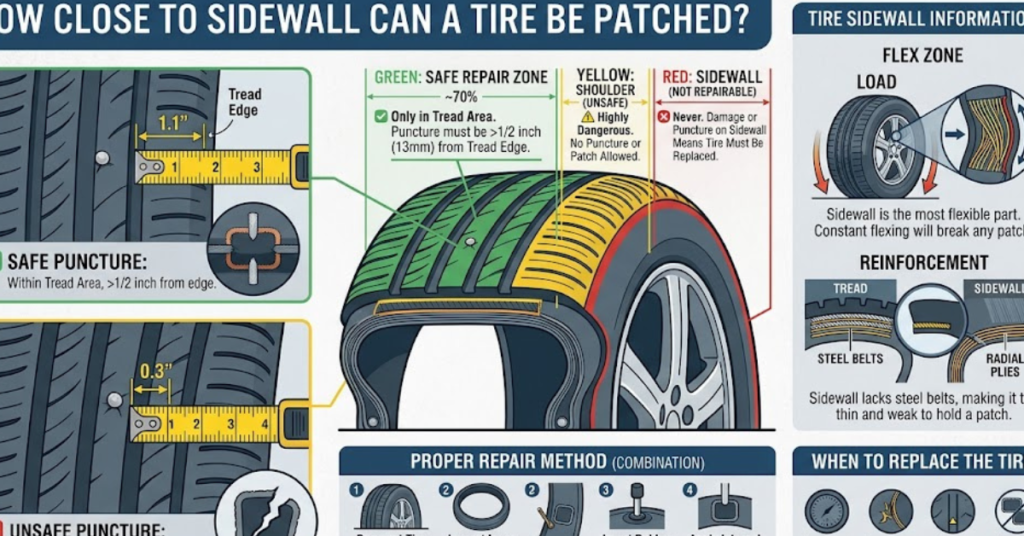
A tire can only be safely patched in the center tread area — at least 1 inch (2.5 cm) away from the sidewall.
Safe Repair Zone
A puncture is repairable if it is:
- Located in the central tread
- At least 1 inch from the sidewall
- Smaller than 1/4 inch (6mm)
- Not angled or torn
If the damage is closer than 1 inch to the sidewall, most professionals will recommend replacing the tire.
Why You Shouldn’t Patch Near the Sidewall
Patching too close to the sidewall may seem like a money-saving shortcut, but it can create serious risks:
- Increased chance of blowout
- Weak structural integrity
- Air leaks over time
- Uneven tire wear
- Poor vehicle handling
The sidewall flexes constantly, and patches are not designed to handle that stress.
Repairable vs Non-Repairable Tire Damage
Repairable
- Small nail punctures in tread
- Straight puncture holes
- Single damage area
- No internal tire damage
Not Repairable
- Punctures in sidewall
- Damage within 1 inch of sidewall
- Cuts or tears
- Bulges or bubbles
- Multiple punctures close together
Professional Tire Repair Guidelines
Industry standards (like USTMA and tire manufacturers) follow these repair rules:
- Repair only in tread area
- Use patch-plug combo from inside
- Inspect tire internally
- Avoid repairing sidewall completely
- Limit puncture size to 1/4 inch
These guidelines ensure long-term safety and performance.
Can You Plug a Tire Near the Sidewall?
Technically, some shops may plug a tire near the shoulder, but it’s not recommended.
Tire plugs:
- Are temporary fixes
- May fail under pressure
- Aren’t safe for long-term driving
If the puncture is near the sidewall, replacement is safer — especially for highway driving.
When You Should Replace Instead of Patch
Replace the tire if:
- Damage is on the sidewall
- Puncture is too close to edge
- Tire has internal cord damage
- Hole is larger than 1/4 inch
- Tire tread is already worn
Safety should always come first — tires are your vehicle’s only contact with the road.
Cost Comparison: Patch vs Replace
| Option | Average Cost | Safety Level |
| Tire Patch | $10 – $30 | High (if in safe zone) |
| Tire Plug | $5 – $20 | Temporary |
| New Tire | $80 – $250 | Safest |
Sometimes replacing the tire is more economical long-term.
FAQs
How close to sidewall can a tire be patched safely?
A tire can usually be patched only if the puncture is at least 1 inch away from the sidewall in the tread area.
Can a tire shop patch near the shoulder?
Most professional shops will refuse to patch damage near the shoulder due to safety risks.
Is a plug safe near the sidewall?
No. Plugs near the sidewall are temporary and unsafe for long-term use.
Can sidewall damage ever be repaired?
No. Sidewall damage cannot be safely repaired — replacement is required.
What happens if you patch too close to the sidewall?
The patch may fail, causing air loss or a potential blowout.
Conclusion
Understanding how close to sidewall can a tire be patched is crucial for safe driving. The general rule is simple: repairs should only be done in the central tread area, at least 1 inch from the sidewall. Anything closer increases the risk of failure and should be replaced instead.
When in doubt, have a professional inspect the tire. A small investment in safety today can prevent major problems later.