
Have you ever typed a sentence and paused, wondering whether to use sense or since? You’re definitely not alone. These two words sound similar, but they have completely different meanings and uses in English grammar.
Understanding Sense vs Since is important because using the wrong one can change the meaning of your sentence—or make it confusing altogether. In this guide, we’ll break down the sense vs since definition, show clear examples, and give you simple memory tricks so you never mix them up again.
Let’s make this easy.
Sense vs Since: Quick Definition
Before diving deeper, here’s the simplest way to understand the difference:
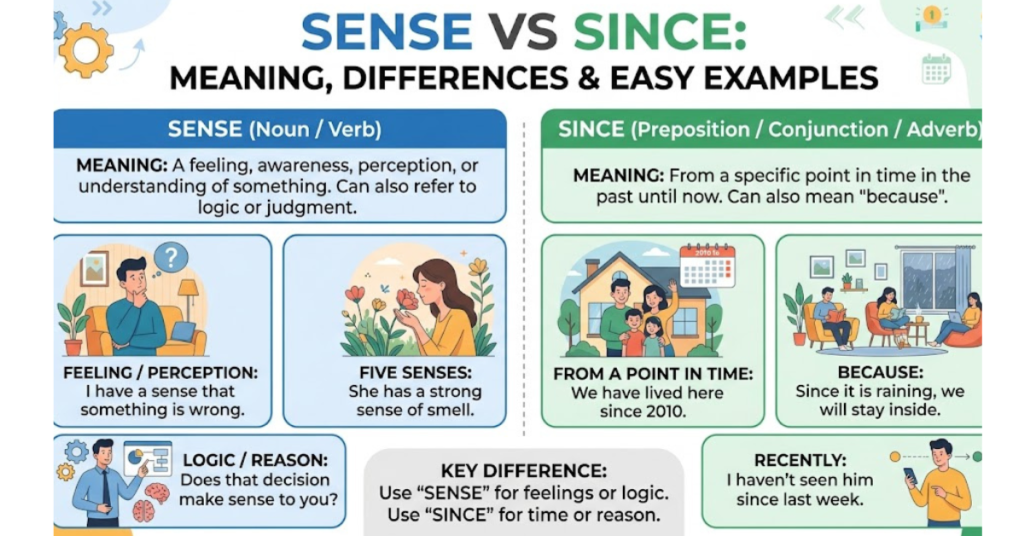
- Sense relates to feeling, understanding, awareness, or one of the five senses.
- Since usually refers to time (“from then until now”) or reason (“because”).
Example:
- That makes perfect sense.
- I have lived here since 2020.
Even though they sound alike, they belong in very different situations.
Sense vs Since Definition Explained
Let’s look at each word separately.
What Does “Sense” Mean?
The word sense is usually a noun, but it can also be a verb.
As a noun, “sense” means:
1. Understanding or Logic
Example:
- Your explanation makes a lot of sense.
This means the explanation is logical and understandable.
2. Physical Perception
It can refer to one of the five senses:
- sight
- smell
- hearing
- taste
- touch
Example:
- Dogs have a strong sense of smell.
3. Feeling or Awareness
Example:
- She had a sense that something was wrong.
As a verb, “sense” means:
To feel or detect something.
Example:
- I could sense tension in the room.
What Does “Since” Mean?
The word since is commonly used as a preposition, conjunction, or adverb.
“Since” usually means:
1. From a Past Time Until Now
Example:
- I have known her since childhood.
This shows time continuing from the past to the present.
2. Because
Example:
- Since it was raining, we stayed inside.
Here, “since” means the same as “because.”
Main Difference Between Sense and Since
The easiest way to remember Sense vs Since is this:
Ask yourself:
Are you talking about understanding or feeling?
→ Use sense
Are you talking about time or reason?
→ Use since
That one question solves most confusion.
Sense vs Since in Sentences
Examples make everything clearer.
Examples of “Sense”
- It doesn’t make any sense.
- She has a good sense of humor.
- I could sense danger nearby.
- His words made perfect sense.
Examples of “Since”
- I’ve been working here since Monday.
- Since you’re here, let’s begin.
- They’ve been friends since school.
- We canceled the trip since the weather was bad.
Common Mistakes with Sense vs Since
Many learners confuse these words because of pronunciation.
Here are incorrect and correct examples:
Incorrect:
- I have been tired sense yesterday.
Correct:
- I have been tired since yesterday.
Incorrect:
- Your idea makes no since.
Correct:
- Your idea makes no sense.
A quick check for time vs understanding usually fixes the issue.
Easy Memory Trick for Sense vs Since
Here’s a simple trick:
“Since” = Starts with Time
Think:
SincE = timE
Both end with “E,” helping you remember time-related usage.
“Sense” = Feeling and Understanding
Think of your five senses:
- sight
- smell
- hearing
- taste
- touch
This helps connect “sense” to awareness and understanding.
Grammar Tips for Using Since
Because “since” often refers to time, it frequently appears with perfect tenses.
Example:
- I have lived here since 2018.
Notice the use of have lived, not just “live.”
Common structure:
Subject + have/has + past participle + since + time
Example:
- She has worked here since January.
This is a very common grammar pattern.
Why People Confuse Sense and Since
There are three main reasons:
1. Similar Pronunciation
They sound nearly identical in fast speech.
2. Typing Errors
Autocorrect doesn’t always help.
3. Lack of Context Awareness
People often focus on sound rather than meaning.
That’s why understanding context matters more than spelling alone.
Sense vs Since in Writing and SEO Content
Writers, bloggers, and students often search for sense vs since definition because both words are common in professional writing.
Using the wrong one can:
- weaken credibility
- create confusion
- affect academic writing quality
- make blog content look unprofessional
Even small grammar mistakes can impact trust, especially online.
Quick Comparison Table
| Word | Meaning | Example |
| Sense | Understanding, feeling, awareness | That makes sense |
| Since | Time from past until now | I’ve been here since 9 AM |
| Since | Because | Since it’s late, let’s leave |
This table makes the distinction easier to remember.
FAQs About Sense vs Since
Is it “make sense” or “make since”?
The correct phrase is make sense.
Example:
- Your answer makes sense.
“Make since” is incorrect.
Can “since” mean “because”?
Yes, absolutely.
Example:
- Since you called, I decided to wait.
Here, “since” means “because.”
Is “sense” always a noun?
No. It can also be a verb.
Example:
- I sensed trouble immediately.
In this case, it means to detect or feel something.
Which is more common: sense or since?
Both are common, but they are used in different situations.
- Sense appears often in explanation and emotion.
- Since appears often in time-based grammar and reasoning.
How do I remember sense vs since easily?
Use this simple rule:
- Sense = understanding or feeling
- Since = time or reason
This works in almost every case.
Conclusion
Mastering Sense vs Since is easier than it seems once you understand the core difference. If your sentence is about logic, feelings, or awareness, use sense. If it refers to time or gives a reason, use since.
The confusion usually comes from pronunciation, but context always reveals the right choice. By remembering the simple rule—sense for understanding, since for time or reason—you’ll avoid one of the most common English mistakes.