
You’ve probably paused mid-sentence wondering: naive or nieve—which one is correct? You’re not alone. This is one of those deceptively simple spelling questions that trips up even confident writers.
In this article, we’ll break down the difference, explain the meaning, and show you exactly how to use the correct form naturally. By the end, you’ll never hesitate again when choosing between naive or nieve.
Naive or Nieve: Which One Is Correct?
Let’s settle it right away:
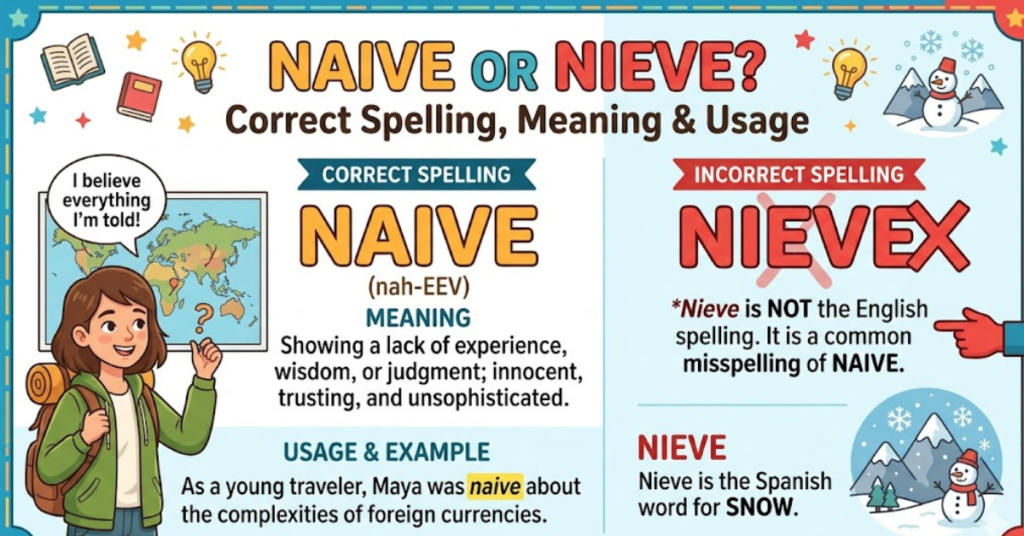
The correct spelling is “naive.”
“Nieve” is incorrect in English.
The confusion often comes from how the word sounds. English pronunciation can be misleading, and naive doesn’t follow typical spelling patterns.
What Does “Naive” Mean?
The naive meaning refers to someone who is:
- Innocent or inexperienced
- Lacking worldly knowledge
- Trusting or overly simple in thinking
Example Sentences:
- She was naive to believe everything she read online.
- His naive optimism made him easy to trust.
It’s not always negative—sometimes it suggests honesty or purity of thought.
Why Do People Write “Nieve”?
If you’ve ever typed “nieve,” there’s a good reason for it.
Common Causes of the Confusion:
- Phonetic spelling: It sounds like “neeve”
- Typing habits: “ie” vs “ei” confusion is common
- Lack of exposure: The correct spelling isn’t intuitive
Interestingly, “nieve” is actually a word—but not in English. In Spanish, nieve means “snow,” which adds to the confusion for multilingual speakers.
How Do You Spell Naive Correctly?
If you’re asking, how do you spell naive or nieve, here’s the simple rule:
Naive (correct)
Nieve (incorrect in English context)
Memory Trick:
Think of “naive” as:
“Na + ive” → like “native” without the “t”
Or remember:
“Naive people believe everything—even tricky spellings.”
Naive in Everyday Language
You’ll often see “naive” used in different contexts:
1. Personal Traits
- “He’s too naive to notice the scam.”
2. Professional Settings
- “That’s a naive approach to business strategy.”
3. Neutral or Positive Tone
- “Her naive curiosity led to great discoveries.”
The tone depends heavily on context—it can be critical or gently appreciative.
Common Mistakes to Avoid
When dealing with is it naive or nieve, here are a few pitfalls:
- Writing “nieve” in formal writing
- Assuming pronunciation equals spelling
- Overusing the word in negative contexts
Quick Tip:
If your spellchecker flags it, trust it—“nieve” won’t pass.
Related Words and Variations
Understanding related forms can help reinforce correct usage:
- Naively (adverb): He naively trusted them.
- Naivety / Naivete (noun): Her naivety was obvious.
Both spellings of the noun are accepted, though “naivety” is more common in British English.
FAQs
1. Is it naive or nieve?
The correct spelling is naive. “Nieve” is not an English word in this context.
2. What is the naive meaning?
It describes someone who is inexperienced, innocent, or overly trusting.
3. How do you spell naive or nieve correctly?
Always spell it naive. A helpful trick is to remember it looks like “native” without the “t.”
4. Is “naive” a negative word?
Not always. It can be neutral or even positive depending on context.
5. Why is “naive” spelled that way?
It comes from French origins, which explains its unusual spelling pattern.
Conclusion
When it comes to naive or nieve, the answer is simple once you know it: “naive” is correct, every time. While the pronunciation might lead you astray, a quick memory trick and a bit of practice will make it second nature.
Language quirks like this are common, but mastering them sharpens your writing and boosts your confidence. If you found this helpful, keep exploring similar word distinctions—you’ll be surprised how many small mistakes you can eliminate with just a little awareness.