
Ever typed scraped when you actually meant scrapped—or the other way around? Many people make this mistake. Writers often confuse scraped vs scrapped meaning because the words look similar and sound alike in casual speech. However, they carry completely different meanings.
In this guide, we explain scraped vs scrapped in a clear and practical way. You’ll understand what each word means, when to use it, and how to avoid awkward mix-ups in writing or conversation.
What Does “Scraped” Mean?
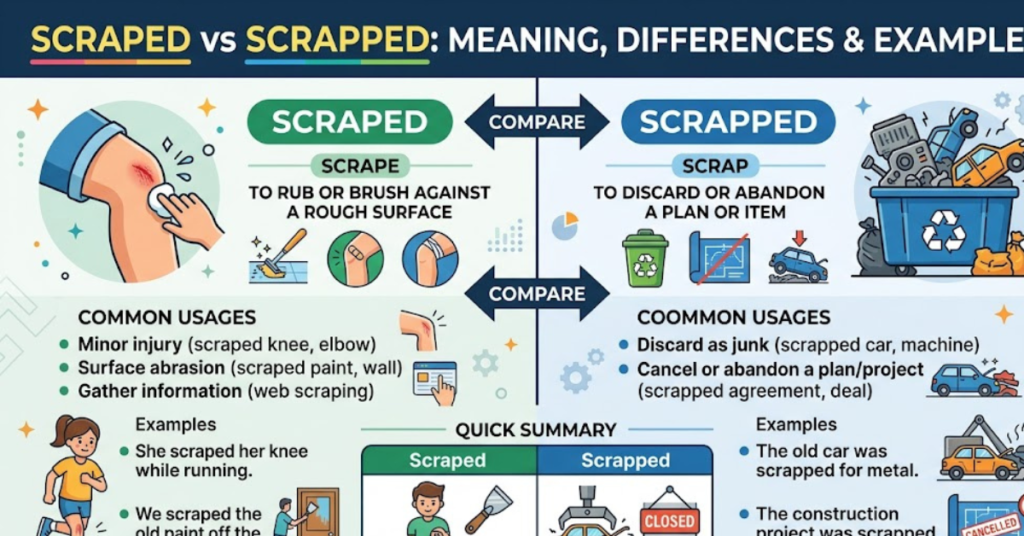
The verb scrape means to rub against a surface or remove something from it.
Common meanings of scraped:
- Removing something by rubbing
- Causing a minor injury or graze
- Extracting data in a digital context
Examples:
- I scraped my knee while playing football.
- She scraped the paint off the wall.
- The company scraped data from public websites.
Key idea:
Think of scraped as removing or brushing something off a surface.
What Does “Scrapped” Mean?
The verb scrap means to discard, cancel, or abandon something.
Common meanings of scrapped:
- Throwing something away
- Canceling a plan or project
- Breaking something down for parts
Examples:
- They scrapped the project due to budget cuts.
- I scrapped my travel plans at the last minute.
- They scrapped the old car for metal.
Key idea:
Think of scrapped as completely discarding or canceling something.
Scraped vs Scrapped: The Core Difference
You can understand scraped vs scrapped meaning more easily with this comparison:
- Scraped → refers to removing, rubbing, or grazing
- Scrapped → refers to canceling, discarding, or abandoning
Easy memory trick:
- Scraped = Surface action (removing or rubbing)
- Scrapped = Stopped or thrown away
When to Use Scraped vs Scrapped
You may know the difference, but you still need to apply it correctly.
Use “scraped” when you:
- Describe physical contact or friction
- Mention minor injuries
- Talk about data extraction
Use “scrapped” when you:
- Cancel a plan
- Discard something
- Abandon a project
Common Mistakes to Avoid
Writers often mix these up. Watch out for these errors:
- “The company scraped the project.”
Correct: “The company scrapped the project.” - “I scrapped my elbow on the wall.”
Correct: “I scraped my elbow on the wall.”
Why this matters:
Choosing the wrong word can change your meaning completely and confuse your reader.
Why People Confuse Scraped and Scrapped
Several factors cause this confusion:
- Similar spelling (only one letter differs)
- Overlapping pronunciation in fast speech
- Context confusion, since both can imply “removal”
When you understand the scraped vs scrapped difference, you communicate more clearly and confidently.
Quick Usage Checklist
Before you send a message or finalize your writing, ask yourself:
- Am I removing something from a surface? → Use scraped
- Am I canceling or discarding something? → Use scrapped
FAQs
1. What is the difference between scraped vs scrapped meaning?
“Scraped” describes removing or grazing something, while “scrapped” means canceling or discarding something.
2. Can scraped and scrapped be used interchangeably?
No. Each word has a distinct meaning and should be used in the correct context.
3. Is data scraping related to scrapped?
No. Data scraping uses scraped, which refers to extracting information from websites.
4. Which is correct: “plans were scraped” or “plans were scrapped”?
Use “plans were scrapped” because it means canceled.
5. How can I remember the difference easily?
Think: scraped = surface, scrapped = stopped.
Conclusion
Understanding scraped vs scrapped meaning helps you write with clarity and precision. One word focuses on removing something physically or digitally, while the other deals with canceling or discarding.
Remember this simple rule: scraped relates to surfaces, scrapped relates to decisions. Keep that distinction in mind, and you’ll avoid this common mistake every time.