
Have you ever paused mid-sentence wondering “is it manuel or manual?” You’re not alone. This common spelling confusion trips up students, writers, and even professionals.
The focus keyword manuel or manual might look like a small difference, but it can completely change the meaning of your sentence. In this guide, we’ll break down the correct spelling, explain the difference, and show you how to use each word confidently in everyday writing.
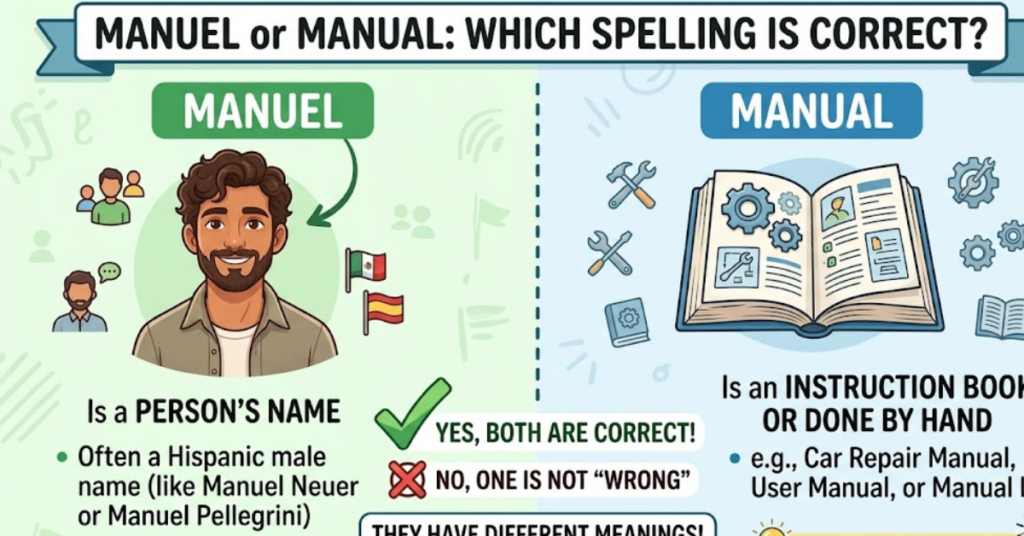
Manuel or Manual: Which Is Correct?
Let’s clear this up right away:
- “Manual” is the correct word in most contexts.
- “Manuel” is usually a name, not a standard English word.
So if you’re asking “manuel or manual which is correct”, the answer depends on what you mean—but in general writing, manual is almost always the right choice.
What Does “Manual” Mean?
The word manual has several meanings depending on context. Here are the most common ones:
1. A Book or Guide
A manual book is a set of instructions explaining how something works.
Examples:
- “I read the instruction manual before using the machine.”
- “The software manual is very detailed.”
2. Done by Hand
Manual can describe something done physically rather than automatically.
Examples:
- “This job requires manual labor.”
- “The process is entirely manual.”
3. Related to Cars
When people search for “manuel or manual car”, they usually mean manual car.
A manual car is one where the driver changes gears using a clutch and gear stick.
What Does “Manuel” Mean?
Here’s where things get simple:
- Manuel is a proper noun (a name).
- It’s commonly used in Spanish, Portuguese, and other languages.
Examples:
- “Manuel is my neighbor.”
- “I spoke with Manuel yesterday.”
So if you’re writing about a person, Manuel might be correct. Otherwise, it’s likely a mistake.
Manuel or Manual Difference
Understanding the manuel or manual difference comes down to usage:
| Word | Meaning | Usage Type |
| Manual | Instruction, hand-operated | Common English word |
| Manuel | A person’s name | Proper noun |
A quick tip:
If you’re talking about instructions, work, or machines, go with manual.
How to Spell Manuel or Manual Correctly
If you’re unsure about “how to spell manuel or manual”, try this trick:
- Manual = “man + u + al” → think “use your hands”
- Manuel = a name → think of a person
Easy Memory Tip
If it’s about instructions or effort, it’s manual.
If it’s about a person, it’s Manuel.
Common Mistakes People Make
Here are a few examples where people often go wrong:
- “Read the user manuel”
- “Read the user manual”
- “I drive a manuel car”
- “I drive a manual car”
- “The manuel explains everything”
- “The manual explains everything”
These small errors can affect clarity and even professionalism in writing.
Why This Confusion Happens
There are a few reasons why people mix up manuel or manual:
- They sound similar when spoken quickly
- Typing errors (especially on mobile devices)
- Lack of familiarity with the word “Manuel” as a name
The good news? Once you understand the difference, it becomes easy to avoid.
FAQs
1. Is it manuel or manual?
In most cases, manual is correct. “Manuel” is typically a name.
2. What is a manual car?
A manual car requires the driver to shift gears manually using a clutch pedal and gear stick.
3. What is a manual book?
A manual book is a guide that explains how to use or operate something.
4. Why do people confuse manuel or manual?
They look and sound similar, which leads to spelling mistakes, especially in fast typing.
5. Can “Manuel” ever be correct?
Yes, but only when referring to a person’s name.
Conclusion
To wrap it up, the debate over manuel or manual is simpler than it seems. In everyday writing, manual is the correct word for instructions, tasks, or machines. “Manuel,” on the other hand, is just a name and rarely used outside that context.
Getting this right not only improves your writing but also boosts clarity and professionalism. Next time you hesitate, just remember: if it’s about doing something or learning how something works, it’s manual.
Want to sharpen your grammar further? Keep exploring similar commonly confused words—you’ll be surprised how much they improve your writing.