
Punctuation can completely change the meaning of a sentence, and the semicolon is often the most confusing mark of all. Many writers either avoid it or use it incorrectly. Understanding when to use semicolon helps you write clearer, more polished sentences without sounding overly formal.
This guide explains the key rules, shows practical examples, and compares semicolons with commas, colons, and dashes. By the end, you’ll know exactly when to use one — and when not to.
What Is a Semicolon?
A semicolon (;) connects two closely related ideas. It’s stronger than a comma but not as final as a period.
Example:
- The rain stopped; the streets quickly filled with people.
Both parts are complete sentences that share a connection.
Main Situations Where a Semicolon Works
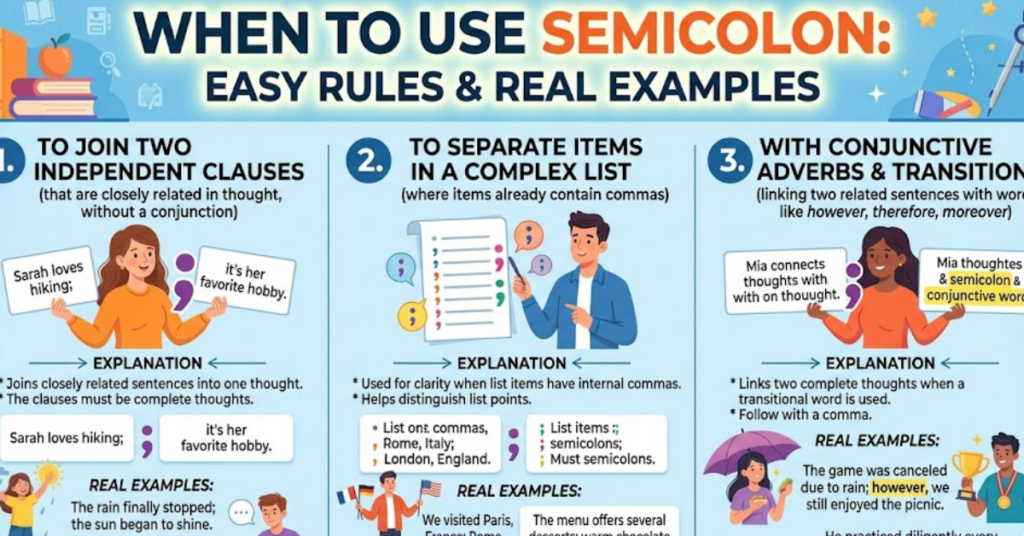
1. Connecting Related Independent Clauses
Use a semicolon to link two complete sentences that are closely connected.
Examples:
- She enjoys reading; her brother prefers watching movies.
- The store was closed; we came back the next day.
If a period works, a semicolon usually works too.
2. Before Transitional Words
Semicolons are useful before words like however, therefore, meanwhile, and otherwise.
Examples:
- I wanted to travel; however, I didn’t have enough time.
- He studied consistently; therefore, his grades improved.
This structure improves flow and clarity.
3. In Complex Lists
When list items already contain commas, semicolons separate them more clearly.
Example:
- The conference included speakers from Lahore, Pakistan; Dubai, UAE; and London, UK.
Without semicolons, the sentence would feel cluttered.
Semicolon vs Comma
A comma is lighter and usually pairs with conjunctions like and, but, or so.
Comma Example:
- I was tired, so I went home.
Semicolon Example:
- I was tired; I went home.
Use a semicolon when you want a stronger connection without adding a conjunction.
Semicolon vs Colon
These two marks serve different purposes:
- Semicolon → connects related ideas
- Colon → introduces information
Examples:
- She loves writing; it helps her relax.
- She loves three hobbies: writing, painting, and hiking.
Semicolon vs Dash
A dash is more casual and expressive, while a semicolon feels structured.
Semicolon:
- The deadline is close; we must finish today.
Dash:
- The deadline is close — we must finish today.
Choose based on tone: formal writing favors semicolons.
Tips for Using Semicolons on the SAT
Standardized tests often check punctuation accuracy. Remember:
- Both sides must be complete sentences
- A semicolon can replace a period
- Avoid using it with conjunctions like “and”
Example:
- The exam was difficult; many students struggled.
Quick Reference Guide
Use a semicolon to:
- Connect related sentences
- Link ideas with transitional words
- Separate complex list items
- Replace a period in formal writing
Avoid using it when:
- One part isn’t a complete sentence
- A comma with conjunction works better
- The ideas are unrelated
Common Mistakes
Incorrect:
- I finished my work; and I went home.
Correct:
- I finished my work, and I went home.
- I finished my work; I went home.
Frequently Asked Questions
Is a semicolon stronger than a comma?
Yes. It creates a clearer separation between closely related ideas.
Can semicolons be used in essays?
Yes, especially in academic or formal writing where sentence variety matters.
Should I use semicolons often?
Use them sparingly. They’re helpful but shouldn’t appear in every paragraph.
Are semicolons tested on the SAT?
Yes. They often appear in grammar and punctuation questions.
Can semicolons separate list items?
Yes, particularly when list items include commas.
Conclusion
Semicolons aren’t complicated once you understand their purpose. They connect related thoughts, improve readability, and add sophistication to your writing. By learning how they compare with commas, colons, and dashes, you’ll use them naturally and confidently.
Practice using semicolons in your next piece of writing, and you’ll quickly see how they enhance clarity without overcomplicating your sentences.