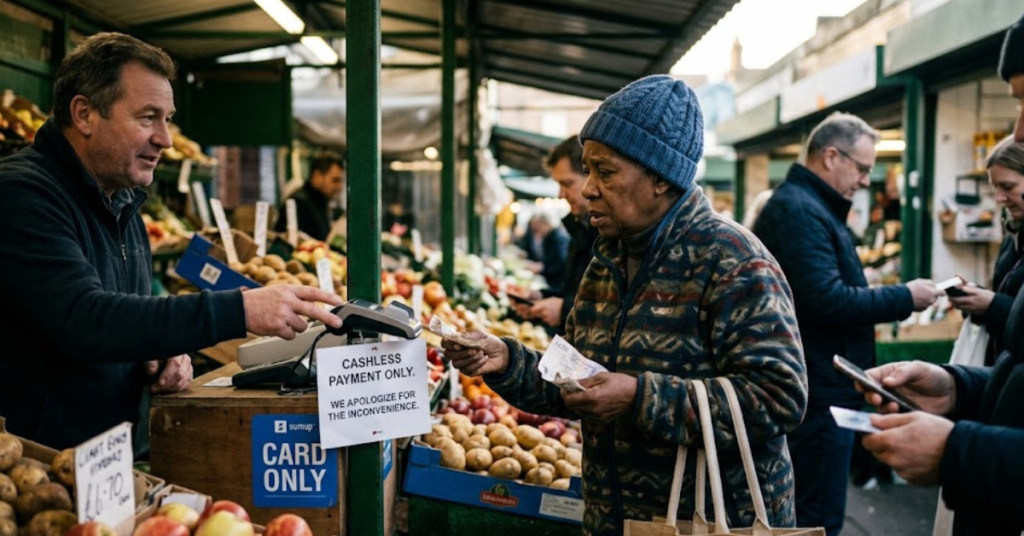

Imagine walking into a grocery store, picking up essentials, and then realizing the cashier won’t accept cash. For millions of people, this scenario isn’t hypothetical—it’s becoming reality. As digital payments grow, how might a cashless society negatively impact someone who is unbanked or underbanked? This question matters more than ever.
A cashless society promises convenience, speed, and security, but it can also leave vulnerable populations behind. People without traditional bank accounts—or those relying on alternative financial services—face unique barriers when cash disappears. This article explores the real-world consequences, supported by practical examples and solutions.
What Does “Unbanked” and “Underbanked” Mean?
Before diving deeper, it’s helpful to clarify these terms:
- Unbanked: Individuals who do not have a checking or savings account with a traditional bank.
- Underbanked: People who have a bank account but rely heavily on alternative services like payday loans, money orders, or check-cashing stores.
These groups often depend on cash transactions, making a cashless environment especially challenging.
Financial Exclusion in a Cashless Economy
One of the biggest concerns about how a cashless society negatively impacts someone who is unbanked or underbanked is financial exclusion.
Without access to digital payment systems, individuals may:
- Be unable to shop at cashless stores
- Struggle to pay for transportation or parking
- Face barriers when booking travel or services online
- Miss out on discounts available only through apps
This creates a two-tiered economy, where digital users benefit and cash users fall behind.
Increased Transaction Fees and Hidden Costs
Reliance on Alternative Financial Services
Unbanked and underbanked individuals often use:
- Prepaid debit cards
- Check-cashing services
- Money transfer apps
- Payday lenders
These services frequently charge:
- Activation fees
- Monthly maintenance fees
- ATM withdrawal charges
- Transaction fees
In a cashless society, these costs can add up quickly, reducing already limited income.
Limited Access to Essential Services
Many essential services are moving toward digital-only payments, including:
- Public transportation systems
- Online government services
- Ride-sharing apps
- Food delivery platforms
- Utility bill payments
If someone is unbanked or underbanked, they may struggle to access these services, creating daily inconveniences and long-term disadvantages.
Privacy and Data Concerns
Cash transactions are anonymous. Digital payments, however, create a trail of personal data.
For individuals who:
- Value privacy
- Lack trust in financial institutions
- Share devices or accounts
A cashless society can feel intrusive. This raises concerns about data tracking, identity theft, and financial surveillance.
Technology Barriers and Digital Literacy
Not everyone has:
- A smartphone
- Reliable internet
- Digital payment knowledge
- Updated apps or devices
These technological barriers make it harder to participate in a cashless system. Older adults, low-income individuals, and rural communities are especially affected.
Risk During Emergencies and System Failures
Cashless systems rely on:
- Electricity
- Internet connectivity
- Payment networks
During outages, disasters, or technical failures:
- Cards may stop working
- Apps may crash
- ATMs may be offline
For someone unbanked or underbanked, having cash is often the only backup. Removing it increases vulnerability during emergencies.
Employment and Income Challenges
Some workers—like gig workers, day laborers, or domestic workers—are often paid in cash. A shift to digital-only payments may:
- Require bank accounts
- Delay access to wages
- Introduce withdrawal fees
- Reduce informal job opportunities
This can disproportionately affect those already financially marginalized.
Social Inequality and Economic Divide
When cash disappears, inequality can widen. A cashless society may:
- Exclude low-income individuals
- Limit participation in commerce
- Reduce financial independence
- Increase reliance on expensive services
Over time, this deepens the digital financial divide between socioeconomic groups.
Potential Benefits—But Not for Everyone
It’s important to note that cashless systems offer advantages:
- Faster payments
- Reduced theft risk
- Easy budgeting tools
- Contactless convenience
However, these benefits primarily help people already integrated into the banking system.
Solutions to Reduce Negative Impacts
To minimize how a cashless society negatively impacts someone who is unbanked or underbanked, policymakers and businesses can:
- Keep cash acceptance mandatory in essential services
- Expand access to low-cost bank accounts
- Offer fee-free prepaid cards
- Improve financial literacy programs
- Provide offline digital payment options
- Invest in inclusive fintech solutions
These steps help ensure financial inclusion while embracing innovation.
FAQs
1. Why are some people unbanked or underbanked?
Common reasons include high banking fees, lack of documentation, distrust of banks, low income, or limited access to financial institutions.
2. Is a cashless society inevitable?
Not necessarily. While digital payments are growing, many governments and organizations advocate for keeping cash available to ensure inclusion.
3. How many people are unbanked?
Globally, hundreds of millions of adults remain unbanked, according to World Bank estimates, particularly in low-income and rural communities.
4. Are cashless stores legal everywhere?
Some regions require businesses to accept cash to prevent discrimination against unbanked individuals.
5. Can prepaid cards solve the problem?
They help, but fees and limited acceptance can still create challenges for underbanked users.
Conclusion
So, how might a cashless society negatively impact someone who is unbanked or underbanked? The effects range from financial exclusion and higher fees to reduced access to essential services and increased inequality. While digital payments bring convenience, removing cash entirely risks leaving vulnerable populations behind.
The key takeaway: progress should be inclusive. A balanced approach—where digital innovation coexists with accessible cash options—ensures no one is locked out of everyday life.