
Ever looked at a ruler and felt confused by all those tiny lines? You’re not alone. Learning how to read a ruler is a basic skill, but it can feel tricky at first—especially when dealing with inches, centimeters, millimeters, and decimals.
In this guide, you’ll learn how to read a ruler in inches, cm, mm, and decimals in a simple, practical way. Whether you’re a student, DIY enthusiast, or just brushing up on basics, this article breaks it down step by step.
Understanding the Basics of a Ruler
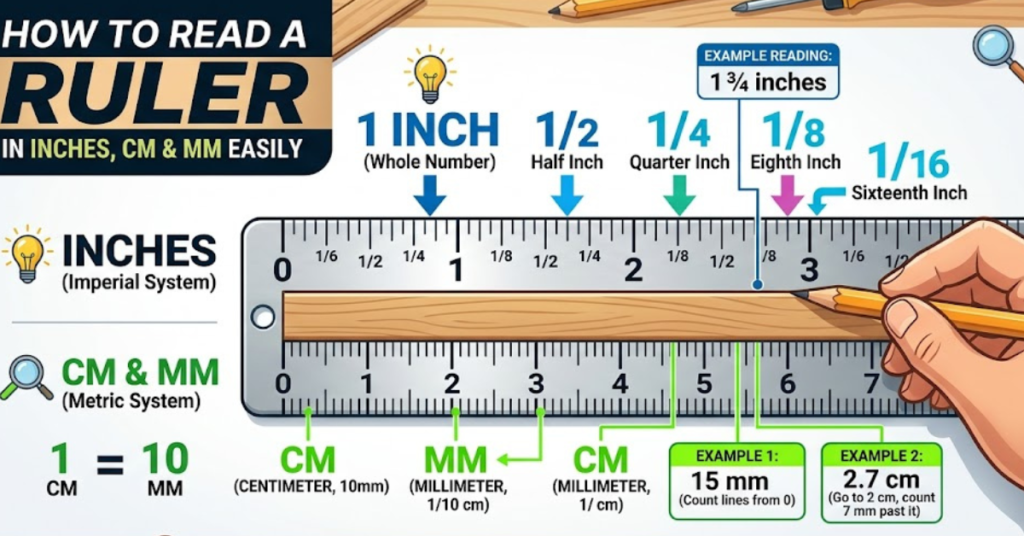
Before diving deeper, let’s quickly understand what a ruler shows. A standard ruler usually measures up to 12 inches (imperial system) or 30 centimeters (metric system).
Key Things to Notice
- Numbers: Represent whole units (inches or centimeters)
- Lines between numbers: Indicate smaller units
- Longer lines: Easier to identify (major units)
- Shorter lines: Represent smaller measurements
How to Read a Ruler in Inches
When learning how to read a ruler in inches, the biggest challenge is understanding fractions.
Inch Breakdown
Each inch is divided into smaller parts:
- 1/2 inch (largest middle line)
- 1/4 inch
- 1/8 inch
- 1/16 inch (smallest lines on most rulers)
Step-by-Step Guide
- Locate the nearest whole inch number
- Count the smaller lines after it
- Identify the fraction they represent
Example
If the measurement is between 2 and 3 inches and lands on the fourth small line after 2, it might be 2 1/4 inches.
How to Read a Ruler in Inches Decimals
Sometimes, measurements are shown in decimals instead of fractions.
Common Conversions
- 1/2 = 0.5
- 1/4 = 0.25
- 3/4 = 0.75
- 1/8 = 0.125
Quick Tip
To understand how to read a ruler in inches decimals, convert fractions into decimals or use a ruler marked in decimals.
Example
Instead of saying 2 1/2 inches, you can say 2.5 inches.
How to Read a Ruler in CM Centimeters
The metric system is easier for many people because it uses base 10.
Structure of a Metric Ruler
- Each number = 1 centimeter
- Each small line = 1 millimeter
- 10 millimeters = 1 centimeter
Steps
- Find the nearest centimeter mark
- Count the smaller lines millimeters
- Add them together
Example
If the mark is 5 cm plus 3 small lines, the measurement is 5.3 cm.
How to Read a Ruler in MM Millimeters
Millimeters are the smallest units on a metric ruler.
Why Use Millimeters?
- More precise measurements
- Common in engineering, crafts, and design
How to Measure in MM
- Count each small line individually
- Each line = 1 mm
Example
If an object reaches the 27th small line, it measures 27 mm.
Practical Tips for Reading a Ruler Accurately
Getting accurate measurements takes a bit of practice. Here are some tips to help:
- Always start from zero, not the edge of the ruler
- Keep your eye level with the measurement to avoid errors
- Use good lighting to see smaller markings
- Practice with everyday objects (books, pens, phones)
Common Mistakes to Avoid
Even simple tools can trip you up. Watch out for these:
- Starting from the wrong point on the ruler
- Confusing millimeters with centimeters
- Misreading fractions in inches
- Ignoring the smallest lines
Real-Life Uses of Reading a Ruler
Understanding how to read a ruler is useful in many situations:
- School assignments and exams
- DIY and home improvement projects
- Sewing and tailoring
- Crafting and design work
FAQs
1. What is the easiest way to learn how to read a ruler?
Start with centimeters since they are simpler, then move to inches and fractions.
2. How many millimeters are in one inch?
There are 25.4 millimeters in one inch.
3. Why are there so many lines on an inch ruler?
They represent fractions like halves, quarters, eighths, and sixteenths for precise measurement.
4. How do I convert inches to decimals quickly?
Memorize common fractions or use a conversion chart for quick reference.
5. Is metric or imperial easier to use?
Most people find the metric system easier because it’s based on multiples of 10.
Conclusion
Learning how to read a ruler doesn’t have to be complicated. Once you understand the difference between inches, centimeters, millimeters, and decimals, it becomes second nature.
Start with the basics, practice regularly, and soon you’ll measure accurately without even thinking about it. If you want to improve further, try applying these skills in real-world tasks like DIY projects or crafts—you’ll pick it up faster than you expect.