
If you’ve ever paused mid-sentence wondering whether to use emerse or immerse, you’re not alone. The confusion around emerse vs immerse is surprisingly common—and for good reason. The words look similar, sound related, and even share roots, but their meanings are quite different.
In this guide, we’ll break things down clearly and conversationally so you can confidently use the right word every time. By the end, you’ll not only understand the difference but also remember it without second-guessing.
What Does “Immerse” Mean?
Let’s start with the more familiar word.
Definition of Immerse
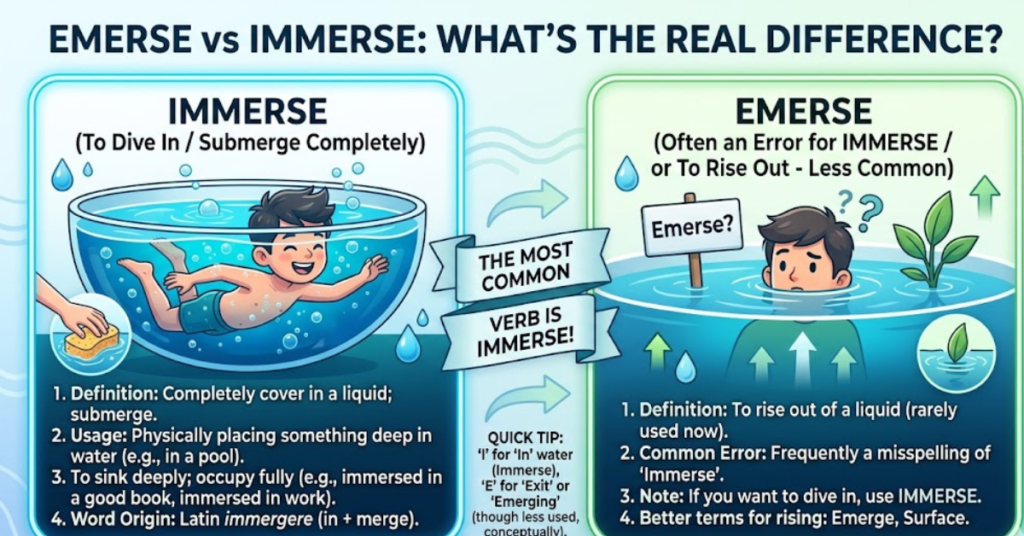
Immerse means to completely involve or submerge something (or yourself) in a particular activity, environment, or liquid.
Common Uses
- Literal meaning: Putting something fully under liquid
- She immersed the cloth in water.
- Figurative meaning: Deep mental or emotional involvement
- He immersed himself in studying for exams.
Key Idea
Think of immerse as going into something deeply—whether physically or mentally.
What Does “Emerse” Mean?
Now for the word that causes the confusion.
Definition of Emerse
Emerse is a much less common word. It describes something that rises out of water or another liquid.
Where It’s Used
- Mostly in botany and scientific contexts
- Emerse plants grow partially above water.
Key Idea
If immerse means going in, emerse means coming out.
Emerse vs Immerse: The Core Difference
Here’s the simplest way to remember the difference:
| Word | Meaning | Direction |
| Immerse | To put into something deeply | Inward |
| Emerse | To rise out of something | Outward |
Quick Memory Trick
- Immerse = “I’m in” → going into something
- Emerse = “Emerge” (similar sound) → coming out
This association makes it much easier to recall under pressure.
Why People Confuse Emerse and Immerse
There are a few reasons this mix-up happens:
- Similar spelling: Only one letter differs
- Shared Latin roots: Both relate to “submerging” concepts
- Rare usage of “emerse”: Most people rarely encounter it
Because immerse is far more common in everyday language, many assume emerse is just a typo—which isn’t entirely wrong in casual writing.
Examples in Real-Life Context
Using Immerse Correctly
- To learn faster, immerse yourself in the language.
- The documentary immerses viewers in history.
Using Emerse Correctly
- These aquatic plants have both submerged and emerse leaves.
- The roots remain underwater while the stems are emerse.
Notice how emerse almost always relates to physical position—especially in scientific descriptions.
When Should You Use Each Word?
Use “Immerse” When:
- Talking about learning or focus
- Describing deep involvement
- Referring to submerging something in liquid
Use “Emerse” When:
- Writing scientific or botanical content
- Describing something partially above water
- You specifically mean “emerging from liquid”
For most everyday writing, you’ll almost always need immerse.
Common Mistakes to Avoid
Here are a few pitfalls to watch out for:
- I want to emerse myself in this book.
Correct: I want to immerse myself in this book. - The emersed sponge soaked water.
Correct: The immersed sponge soaked water. - Using emerse casually in place of emerge
Use emerge instead in general contexts
FAQs
1. Is “emerse” a real word?
Yes, emerse is a real word, but it’s rarely used outside scientific fields like botany.
2. Can I use “emerse” instead of “emerge”?
Not usually. While they’re related, emerge is the correct and widely accepted word in everyday language.
3. Which word is more common?
Immerse is far more common and widely used in both spoken and written English.
4. How can I easily remember the difference?
Think:
- Immerse = in
- Emerse = exit (out)
5. Is “immersed” ever confused with “emersed”?
Yes, especially in writing. But immersed means fully covered or deeply involved, while emersed refers to something rising out of liquid.
Conclusion
Understanding emerse vs immerse doesn’t have to be complicated. Once you see the directional difference—in versus out—everything clicks into place.
For everyday conversations and writing, immerse will almost always be your go-to word. Emerse, on the other hand, stays mostly within scientific or niche contexts.
If you want to sharpen your language further, start paying attention to how words with similar roots shift meaning. It’s a small step that makes a big difference in clarity and confidence.
Now that you’ve got it down, try using immerse correctly in your next sentence—and see how natural it feels.