
If you’ve ever paused mid-sentence wondering “is it immaculate or emaculate?”, you’re not alone. This is one of those small but surprisingly common spelling dilemmas that can trip up even confident writers.
In this article, we’ll break down the difference between immaculate or emaculate, explain the correct meaning, and give you simple ways to remember it for good. By the end, you’ll not only know the right spelling—you’ll use it with confidence.
Immaculate or Emaculate: What’s the Correct Word?
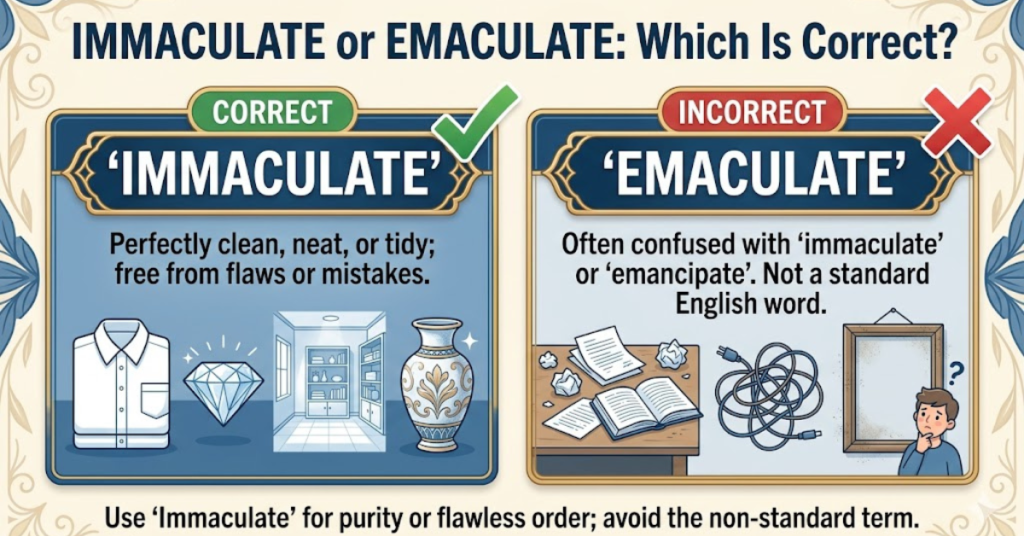
Let’s clear this up right away:
The correct word is immaculate
Emaculate is not a standard English word
So if you’re asking “is it immaculate or emaculate?”, the answer is simple—immaculate is correct.
What Does “Immaculate” Mean?
Definition of Immaculate
Immaculate means:
- Perfectly clean or spotless
- Free from flaws or mistakes
- Pure or without error
Example Sentences
- The room was immaculate, not a speck of dust in sight.
- Her performance was immaculate, with no mistakes at all.
- He kept his car in immaculate condition.
Why Do People Confuse Immaculate with Emaculate?
The confusion between immaculate or emaculate meaning usually comes down to pronunciation and spelling habits.
Common Reasons:
- Phonetic confusion: “Immaculate” can sound like “emaculate” when spoken quickly
- Typing errors: Missing the “i” at the beginning is an easy slip
- Lack of familiarity: People may assume “emaculate” is a variation
But in standard English, “emaculate” simply doesn’t exist.
How to Remember the Correct Spelling
Here are a few easy tricks to lock it in:
1. Break It Down
Im-mac-u-late
Focus on the “im” at the beginning—it’s essential.
2. Think of “Immediate Cleanliness”
Both start with “im”:
- Immaculate = Immediate cleanliness
3. Use Repetition
Write or type the correct version a few times:
- immaculate
- immaculate
- immaculate
It sticks faster than you’d think.
Immaculate in Different Contexts
1. Everyday Use
- Clean homes, organized spaces, neat appearance
2. Professional Settings
- Immaculate presentations
- Error-free reports
3. Figurative Meaning
- Immaculate reputation
- Immaculate timing
It’s a versatile word that works in both literal and abstract situations.
Common Mistakes to Avoid
When dealing with immaculate or emaculate, watch out for these:
- Writing “emaculate” in formal documents
- Assuming both spellings are acceptable
- Autocorrect errors that go unnoticed
Always double-check—especially in professional writing.
FAQs
1. Is it immaculate or emaculate?
It is immaculate. “Emaculate” is incorrect and not recognized in standard English.
2. What is the meaning of immaculate?
It means perfectly clean, flawless, or free from mistakes.
3. Why do people say emaculate?
It’s usually due to mispronunciation or spelling errors, not because it’s a real word.
4. Can emaculate ever be correct?
No, “emaculate” is not considered a valid English word in modern usage.
5. How can I remember the correct spelling?
Focus on the “im” at the beginning and associate it with words like “impeccable” or “impressive.”
Conclusion
When it comes to immaculate or emaculate, the answer is clear: immaculate is the only correct spelling. It’s a powerful word that conveys cleanliness, precision, and perfection—making it a great addition to your vocabulary.
Next time you hesitate, remember: if it’s flawless, it’s immaculate.
If you want to sharpen your writing even further, keep exploring commonly confused words—you’ll be surprised how much more confident your communication becomes.