
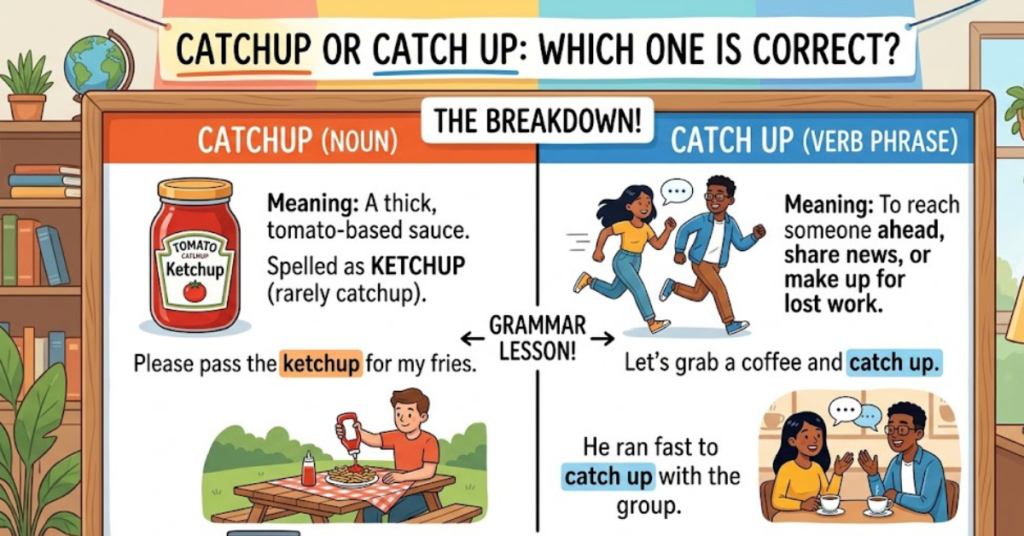

You’ve probably typed catchup or catch up at least once and paused, which one is actually correct? You’re not alone. This small but surprisingly tricky phrase shows up everywhere, from emails to meeting invites. Understanding the difference isn’t just about grammar, it helps your writing look more polished and professional.
In this article, we’ll break down catchup or catch up in simple terms, explore how it’s used in real life, and clear up common confusion, including variations like catch-up. By the end, you’ll know exactly what to use and when.
Catchup or Catch Up: What’s the Difference?
At its core, the confusion comes down to how English treats verbs and nouns.
1. “Catch up” (verb phrase)
“Catch up” is the verb form, and it’s the most commonly used version.
Examples:
- Let’s catch up this weekend.
- I need to catch up on my emails.
- We should catch up with someone we haven’t seen in a while.
Use “catch up” when you’re describing an action.
2. “Catch-up” (noun or adjective)
With a hyphen, “catch-up” becomes a noun or adjective.
Examples:
- Let’s schedule a catch-up meeting.
- We had a quick catch-up over coffee.
Use “catch-up” when referring to a thing or event, like a meeting.
3. “Catchup” (one word)
“Catchup” as a single word is less common and often considered informal or incorrect in many contexts.
It does appear occasionally, especially in casual writing, but most style guides prefer:
- “catch up” (verb)
- “catch-up” (noun/adjective)
In professional writing, it’s safer to avoid “catchup.”
Is It Catchup or Catch Up in Meetings?
This is where people often hesitate: catchup or catch up meeting?
Correct usage:
- Catch-up meeting
- Catch up meeting
- Catchup meeting
Why?
Because “meeting” is a noun, and you’re describing its purpose. So you need the hyphenated adjective form.
Catchup or Catch Up UK vs US Usage
If you’re wondering about catchup or catch up UK differences, here’s the deal:
- Both UK and US English prefer “catch up” (verb) and “catch-up” (noun/adjective).
- “Catchup” is not standard in either variant, though it may appear informally.
So no matter where you are, the rules stay mostly the same.
Catchup or Catch Up With Someone: How to Use It
When talking about reconnecting, the correct phrase is always:
- Catch up with someone
Examples:
- I’d love to catch up with someone from my old team.
- Let’s catch up with someone over lunch next week.
This is always a verb phrase, so no hyphen or single-word version.
Quick Rules to Remember
Here’s a simple way to avoid mistakes:
- Use “catch up” → for actions
- Use “catch-up” → for things (meetings, chats)
- Avoid “catchup” → unless very informal
Handy checklist:
- Action? → catch up
- Event or noun? → catch-up
- Writing professionally? → skip catchup
Common Mistakes to Avoid
Even experienced writers slip up. Watch out for these:
- Writing “catchup meeting” instead of “catch-up meeting”
- Using “catch up” as a noun (e.g., “Let’s have a catch up” — should be “catch-up”)
- Overusing variations inconsistently in the same document
Consistency matters, especially in business communication.
Why This Matters for Clear Communication
It might seem like a small detail, but using the correct form of catchup or catch up improves:
- Professional tone in emails and reports
- Clarity in scheduling meetings
- Credibility in writing
In short, it helps you sound more polished without trying too hard.
FAQs
1. Is it catchup or catch up?
The correct form is usually “catch up” for verbs and “catch-up” for nouns. “Catchup” is rarely recommended.
2. How do you write catch-up meeting?
The correct form is “catch-up meeting” with a hyphen.
3. Is catchup one word correct?
It’s sometimes used informally, but it’s not standard in formal or professional writing.
4. When should I use catch up?
Use “catch up” when describing an action, like reconnecting or finishing tasks.
5. Is there a difference between catch-up and catch up?
Yes:
- “Catch up” = verb
- “Catch-up” = noun or adjective
Conclusion
So, is it catchup or catch up? The answer is simple once you break it down. Use “catch up” for actions and “catch-up” for things like meetings. Avoid the one-word “catchup” unless you’re writing very casually.
Getting this right isn’t just about grammar—it’s about communicating clearly and confidently. Next time you write an email or set up a meeting, you’ll know exactly which version to use.
If you want to sharpen your writing even more, keep exploring common grammar distinctions like this, small tweaks can make a big difference.