
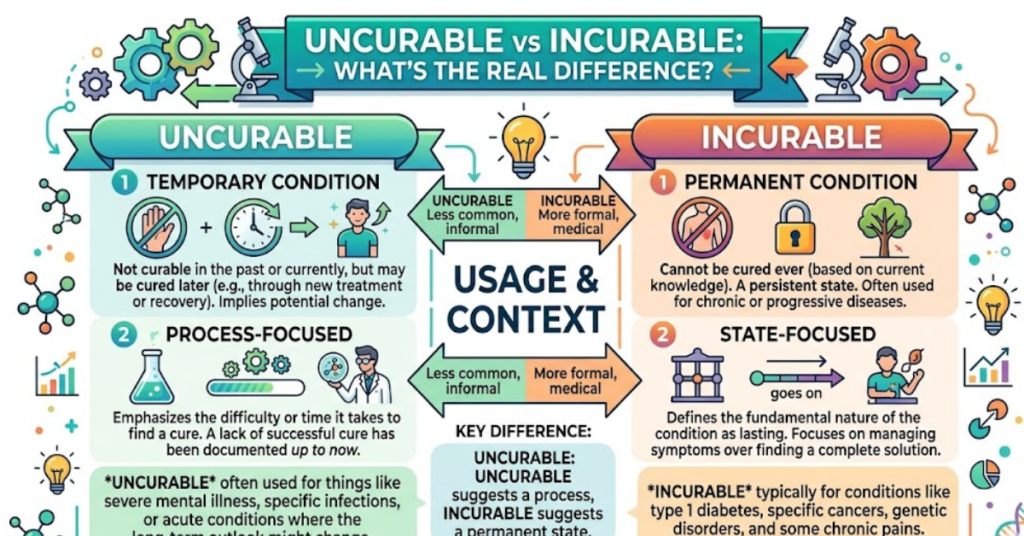

Have you ever wondered whether there’s a real difference between uncurable and incurable? At first glance, they seem identical—and in everyday conversation, people often use them interchangeably. But language has its subtleties, and understanding them helps you communicate more clearly, especially in medical, academic, or professional contexts.
In this article, we break down the meanings, usage, and context of these two words in a simple, conversational way—so you won’t second-guess yourself again.
What Does “Incurable” Mean?
Incurable is the more widely accepted and commonly used term. It describes a condition or situation that cannot be cured or healed.
Key Characteristics of “Incurable”:
- People commonly use it in medical contexts
- Writers accept it in formal speech and writing
- It implies a condition with no known cure
Examples:
- An incurable disease like certain advanced cancers
- Chronic illnesses that doctors can manage but not eliminate
Most dictionaries and style guides recognize incurable as the standard term.
What Does “Uncurable” Mean?
Uncurable technically expresses the same idea—something that cannot be cured—but people rarely use it and often consider it nonstandard or incorrect in formal English.
Why “Uncurable” Is Rare:
- Major dictionaries rarely include it
- Many language experts view it as awkward or redundant
- Native speakers almost never use it in professional settings
Where You Might See It:
- Informal conversations
- Non-native English usage
- Older or lightly edited texts
Uncurable vs Incurable: The Core Difference
Let’s simplify it.
1. Usage and Acceptance
- Incurable → Standard, correct, widely used
- Uncurable → Rare, informal, often avoided
2. Context
Writers prefer incurable in:
- Medical writing
- Academic papers
- Professional communication
Uncurable may appear in casual speech but lacks credibility.
3. Clarity and Tone
When you choose incurable, your writing sounds clearer, more polished, and more credible—especially in serious discussions.
Why “Incurable” Is the Better Choice
If you’re unsure which word to use, go with incurable almost every time.
Here’s why:
- People recognize it globally
- Professionals consistently prefer it
- Native speakers use it naturally
- It avoids awkward phring or confusion
Think of uncurable as understandable—but stylistically weak.
Related Terms and Concepts
Understanding related terms can deepen your clarity:
Chronic vs Terminal
- Chronic: Long-lasting but manageable
- Terminal: Likely to lead to death within a limited time
Treatable vs Curable
- Treatable: You can manage symptoms
- Curable: You can completely eliminate the condition
These distinctions matter, especially in healthcare discussions.
Common Mistakes to Avoid
Watch out for these pitfalls:
- Using uncurable in formal writing
- Assuming both words carry equal acceptance
- Confusing incurable with untreatable
Quick tip:
If you’re writing anything important—emails, essays, or reports—stick with incurable.
FAQs
1. Is “uncurable” a real word?
Yes, but people rarely use it and often treat it as nonstandard. Most experts recommend avoiding it.
2. Which is correct: uncurable or incurable?
Incurable is the correct and widely accepted term in modern English.
3. Can I use “uncurable” in casual conversation?
You can, and people will understand—but it may sound slightly unnatural.
4. Why do both words exist?
English evolved over time, and some forms linger even after falling out of favor. Incurable simply became dominant.
5. Does “incurable” always mean hopeless?
Not at all. Many incurable conditions can still be managed effectively, allowing people to live full lives.
Conclusion
When comparing uncurable vs incurable, the difference lies less in meaning and more in usage and credibility. Both words point to the same idea—but incurable clearly stands out as the correct and professional choice.
If you want your writing to sound natural, confident, and precise, stick with incurable. It’s a small choice that makes a big difference.