
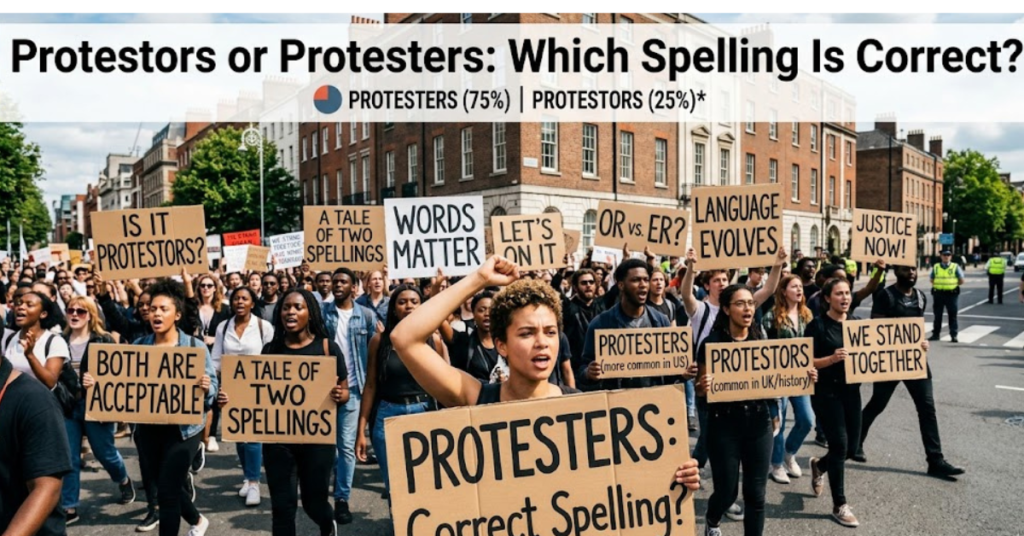

You’ve probably seen both spellings—protestors or protesters—in news articles, social media posts, and even academic writing. So which one is actually correct? And does it depend on where you are or the style guide you follow?
This article breaks down the protestors or protesters spelling debate in a clear, practical way. We’ll look at grammar rules, regional preferences, and what major style guides recommend—so you can use the right form with confidence.
Protestors or Protesters: What’s the Difference?
At first glance, the difference seems minor. Both words refer to people who protest. But technically, only one is widely accepted as standard English.
- Protesters → The correct and preferred spelling
- Protestors → Considered a less common or outdated variant
The word comes from the verb protest, and in English, people who perform an action are usually formed with -er, not -or (e.g., runner, speaker, writer).
Quick Rule
If you’re unsure, go with “protesters.” It’s correct in nearly all contexts.
Is It Protestors or Protesters in AP Style?
If you’re writing for journalism or news content, style guides matter.
According to AP Style (Associated Press):
- The correct form is “protesters”
- “Protestors” is not recommended
Why AP Style Prefers “-ers”
AP style favors consistency with common English patterns. Since most action-based nouns use -er, “protesters” aligns better with standard usage.
Protestors or Protesters UK: Is There a Difference?
One common question is whether British English changes the spelling.
In UK English:
- “Protesters” is still the standard spelling
- “Protestors” may appear occasionally but is not preferred
So whether you’re writing in the US or UK, the answer to “protestors or protesters UK” is essentially the same.
Why Do People Still Use “Protestors”?
Even though “protesters” is correct, “protestors” hasn’t completely disappeared. Here’s why:
1. Confusion with Similar Words
Words like actor, editor, and director end in -or, which leads people to assume the same pattern applies.
2. Historical Usage
“Protestor” has been used in the past, so it occasionally appears in older texts.
3. Typing Habits
Sometimes it’s just a matter of habit or autocorrect errors.
How to Remember the Correct Spelling
If you struggle with is it protestors or protesters, here’s a simple trick:
Think of similar action words:
- Teach → Teacher
- Work → Worker
- Protest → Protester
Stick with the -er ending, and you’ll rarely go wrong.
When Spelling Matters (More Than You Think)
Using the correct spelling isn’t just about grammar—it also affects:
- Credibility: Proper spelling builds trust with readers
- Professional writing: Especially important in journalism and academia
So choosing “protesters” over “protestors” can actually make a difference.
Common Mistakes to Avoid
Here are a few pitfalls people run into:
- Using “protestors” in formal writing
- Mixing both spellings in the same article
- Assuming UK English prefers “-ors”
Best Practice
✔ Always use “protesters” for consistency and correctness
FAQs
1. Is it protestors or protesters?
The correct spelling is “protesters.” “Protestors” is considered nonstandard.
2. Which spelling is used in AP style?
AP style uses “protesters” exclusively.
3. Is “protestors” ever correct?
It’s not technically incorrect, but it’s outdated and rarely recommended in modern writing.
4. Do British and American English differ here?
No—both prefer “protesters.”
5. Why do I still see “protestors” online?
Mostly due to habit, confusion with other words, or lack of editing.
Conclusion
So, when it comes to protestors or protesters, the answer is clear: “protesters” is the correct and widely accepted spelling. It aligns with standard English rules, is preferred in both US and UK usage, and is endorsed by major style guides like AP.
If you want your writing to look polished, and professional, stick with the standard form. Small details like this can have a big impact on how your content is perceived.
If you’re interested in sharpening your writing further, exploring common grammar mistakes like this is a great next step.