

Ever looked at a tape measure and wondered what all those tiny lines actually mean? You’re not alone. Learning how to read a tape measure is one of those simple but essential skills that makes DIY projects, home improvement, sewing, and construction much easier.
Whether you’re trying to understand how to read a tape measure in inches, figure out millimeters, or need a quick cheat sheet, this guide breaks everything down in plain, easy-to-follow language. By the end, you’ll be able to measure confidently without second-guessing yourself.
Understanding the Basics of a Tape Measure
Before diving into details, it’s important to know what you’re looking at. Most tape measures display:
- Inches (imperial system)
- Centimeters (cm)
- Millimeters (mm)
- Fraction markings (1/2, 1/4, 1/8, 1/16, and sometimes 1/32)
Each line represents a specific fraction or unit of measurement.
How to Read a Tape Measure in Inches
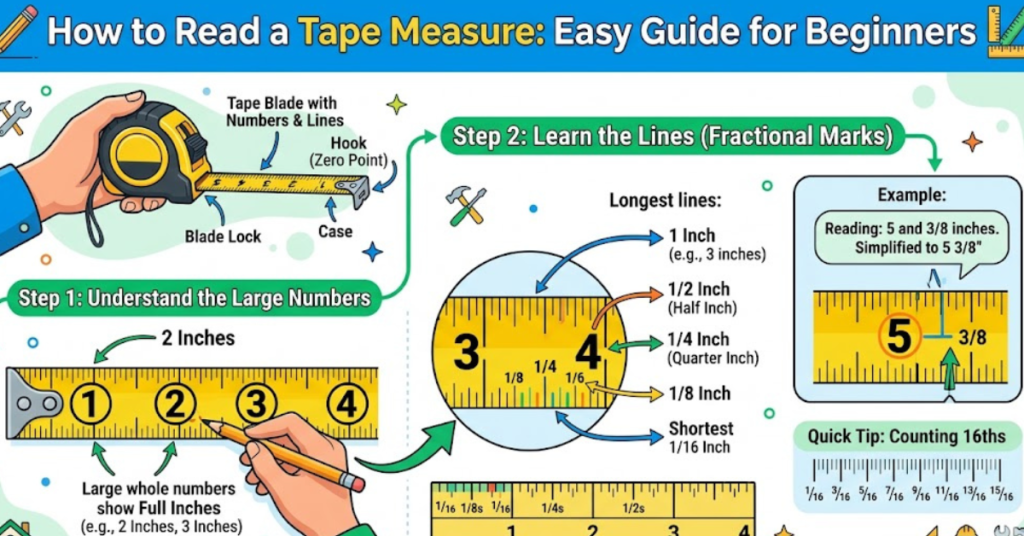
When learning how to read a tape measure in inches, focus on the length of the lines:
- Longest line = 1 inch
- Second longest = 1/2 inch
- Next shorter = 1/4 inch
- Smaller = 1/8 inch
- Smallest = 1/16 inch (sometimes 1/32 inch)
Example:
If your measurement is between 3 and 4 inches:
- Halfway = 3 ½ inches
- One quarter past 3 = 3 ¼ inches
- Smallest line after 3 ½ = 3 9/16 inches
Once you understand this pattern, reading measurements becomes much easier.
32nds: How to Read a Tape Measure 1/32
Some tape measures include extremely fine markings known as 32nds. These are used in precise woodworking or engineering.
Quick breakdown:
- 1 inch = 32 small divisions
- Each smallest mark = 1/32 inch
- Two smallest marks = 1/16 inch
- Four smallest marks = 1/8 inch
If you see a tiny line between two 1/16 marks, that’s a 1/32 increment.
How to Read a Tape Measure in Centimeters cm
Metric measurements are simpler. When learning how to read a tape measure in cm, remember:
- Each numbered mark = 1 cm
- Each small line = 1 mm
- 10 mm = 1 cm
Example:
If the measurement falls between 5 cm and 6 cm:
- Middle = 5.5 cm
- Three small lines after 5 = 5.3 cm
Metric tape measures are often easier because they use decimals instead of fractions.
How to Read a Tape Measure in Millimeters mm
If you’re wondering how to read a tape measure in mm, here’s the simple rule:
- Every tiny line = 1 millimeter
- 10 small lines = 1 centimeter
- Numbers usually show centimeters, not millimeters
Example:
If your measurement ends at 7 small lines after 12 cm:
- That equals 127 mm
This method is especially helpful for precise measurements in crafting or engineering.
Cheat Sheet: How to Read a Tape Measure
Here’s a quick cheat sheet how to read a tape measure:
Inches
- Long line = 1″
- Medium line = 1/2″
- Smaller = 1/4″
- Smaller = 1/8″
- Smallest = 1/16″
- Tiny (optional) = 1/32″
Metric
- Large number = 1 cm
- Small line = 1 mm
- 10 mm = 1 cm
Save this as a quick reference while working.
How to Read a Tape Measure for Dummies Simple Steps
If you’re just starting, follow these steps:
- Find the nearest whole number.
- Count the lines after it.
- Match line size to fraction (inch system).
- Or count millimeters (metric system).
- Combine both numbers.
Example:
- 4 inches + 3 small lines = 4 3/16 inches
That’s it — no complicated math required.
How to Use a Tape Measure Accurately
Knowing how to read a tape measure is only part of the job. Accuracy matters too:
- Hook the metal end firmly
- Keep the tape straight
- Avoid bending the tape
- Read at eye level
- Double-check measurements
Pro tip: Measure twice, cut once.
How to Read a Tape Measure Worksheet (Practice Ideas)
Practicing helps lock in your skills. Try:
- Drawing your own measurement lines
- Measuring household objects
- Printing a how to read a tape measure worksheet
- Guessing measurements before checking
You’ll improve faster with hands-on practice.
Common Mistakes to Avoid
Many beginners make these errors:
- Confusing 1/8 and 1/16 lines
- Ignoring the starting hook movement
- Reading from wrong side (metric vs inches)
- Rounding too early
Take your time and accuracy will improve quickly.
FAQs
What is the easiest way to read a tape measure?
The easiest way is to identify the whole number first, then count the smaller lines and match them to fractions or millimeters.
How do you read a tape measure in inches quickly?
Look for the longest line (inch), then estimate based on the next largest line (½, ¼, ⅛, 1/16).
How many millimeters are in one inch?
There are 25.4 millimeters in one inch.
Why are some lines longer than others?
Line length helps you quickly identify fractions. Longer lines represent larger fractions.
What does 1/32 mean on a tape measure?
It’s the smallest increment on some tape measures, dividing one inch into 32 equal parts.
Is metric easier than imperial?
Yes. Metric uses simple decimals, making how to read a tape measure in mm easier for many people.
Conclusion
Learning how to read a tape measure may seem tricky at first, but once you understand the line sizes and measurement systems, it becomes second nature. Whether you’re working in inches, centimeters, or millimeters, the key is recognizing patterns and practicing regularly.